Evans Waterless Coolant — How One Fluid Changes the Whole Car
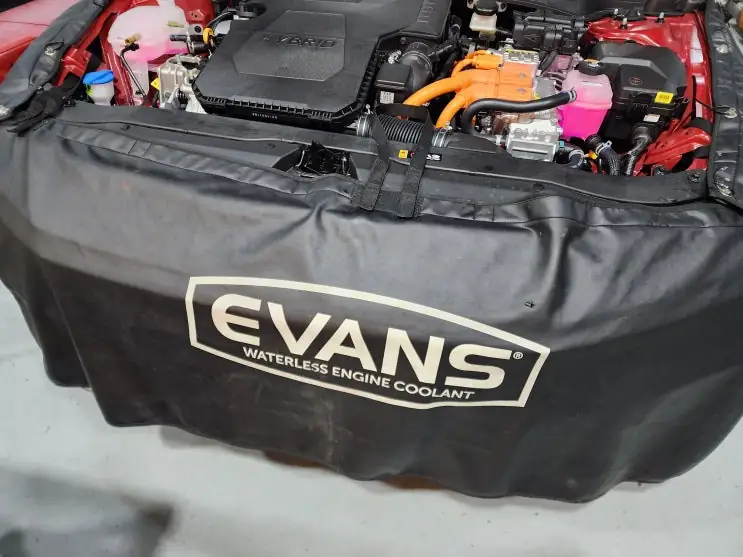
 NHC PREMIUM CARE
Evans · Waterless engine coolant
Runs well, rides smoothly,
stays in good condition for years.
From high-performance cars to the car you plan to keep and cherish.
Evans widens what cooling system care can cover.
Evans is a coolant that uses no water. We apply it in maintenance that takes the heat load of high-output vehicles and the durability of long-term-ownership vehicles into account. Customers who told us noise and vibration were reduced after the service can also be heard in an actual interview.
High-performance cars · New cars · Long-term ownership
For imported and domestic cars alike, we start by checking the vehicle's condition and whether it is a suitable fit.
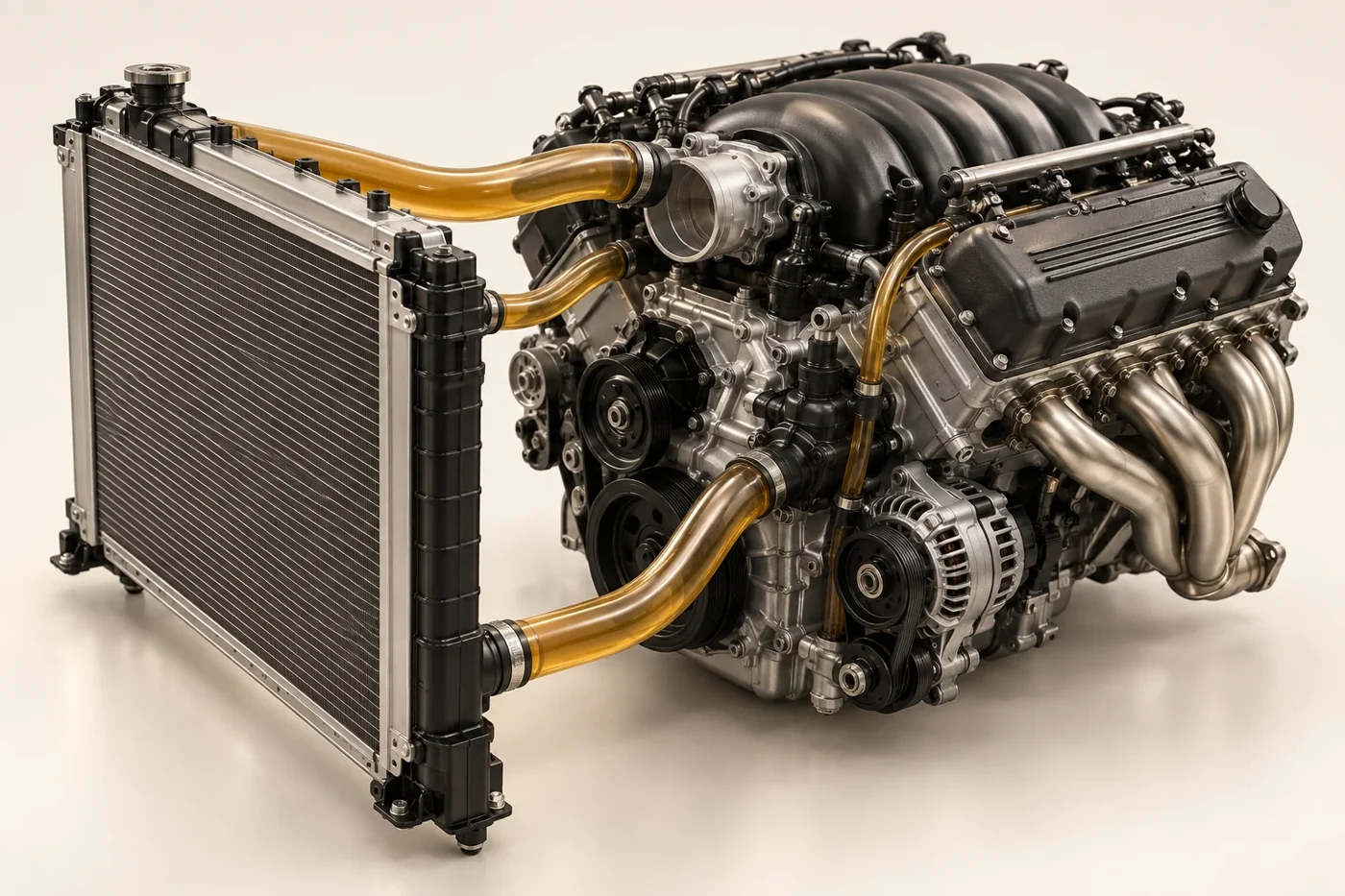 EVANS · PREMIUM COOLING CARE
Care for demanding heat loads
High boiling point and low vapour pressure, applied to the way your vehicle is used.
Quieter, smoother driving
Reduced noise and vibration reported by an owner. BMW 523d interview · individual experience
Long-term cooling system care
Care that considers water-related corrosion and pressure stress in the cooling system.
Koenigsegg, motorsport and our conversion process
EVANS · MOTORSPORT & AUTOMOTIVE
From Koenigsegg to motorsport.
Meet the Evans network abroad.
Hypercars, drag racing, motorcycles, engines and cooling technology.
Evans Korea presents the following brands and organizations in its ‘official sponsors’ material.
Koenigsegg
Swedish hypercars

NHRA
Drag racing

AMA
Motorcycle motorsport

ROTAX
Engine manufacturer

Darton Sleeves
Cylinder liner manufacturer

NARSA
Heat transfer and cooling industry association
Source: Provided by Evans Korea Co., Ltd.
HAGERTY DRIVERS CLUB
A partnership for car enthusiasts
An Evans coolant partnership for members of the Hagerty Drivers Club in the United States.
Official program ↗EVANS MUSEUM PROGRAM
Care that preserves a collector car for the long term
Evans runs a museum partnership program for preserving automobile collections.
About the program ↗NHC MAINTENANCE RECORDS
Maintenance records from our customers' cars
From an Avante Hybrid to a BMW M5. You can see the service and the follow-up maintenance for yourself.
M5 five-year maintenance record →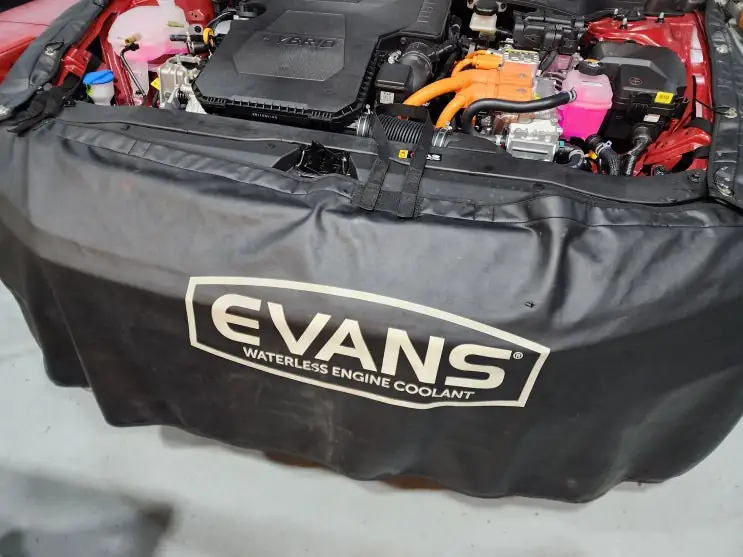
Actual work at NHC
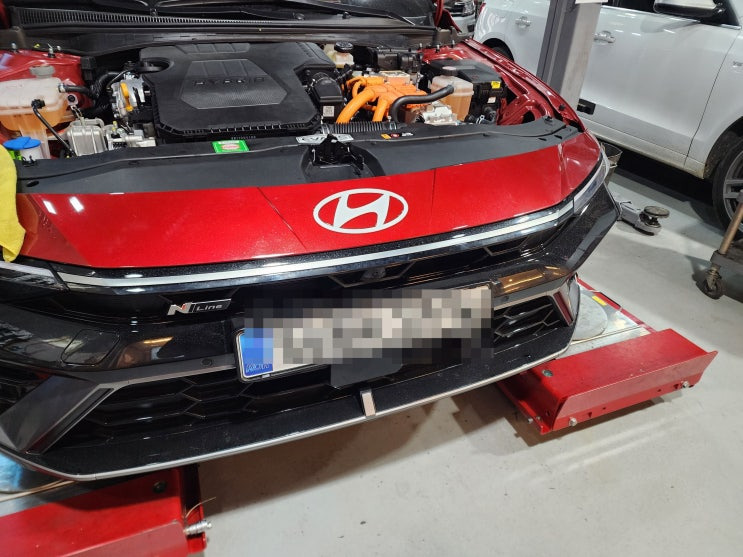
An Avante Hybrid gets the same standard.
We check the vehicle's condition first, then carry out the work to suit the cooling system layout.
The same attention we give to special cars goes into your car as well.
Why have the work done at NHC?
Cooling system experience built up with BG equipment.
That difference carries over to Evans service.
NHC has used BG products since 2003, building experience in oil and cooling system maintenance with dedicated equipment. Even when changing conventional coolant, we have looked at the vehicle's layout and how contaminated the system is, then chosen the flushing and exchange method it needs.
For a conversion to Evans, the step of reducing residual moisture matters on top of that experience. Taking into account the sections that will not drain by opening the drain point alone, we remove the old coolant, flush and dry the system, and after filling we check residual moisture and how the system is operating.
If you have chosen a good product, the service process has to be properly equipped to match it. NHC applies the equipment experience and model-by-model know-how it has built up to Evans work. Customer feedback that noise and vibration were reduced after the service, and the record of a customer choosing Evans again for their next car, can be seen in the videos and the actual case below.
How would it be done on my car?
See it in the actual work on a BMW G21 320d and a Discovery 4.
How did the customer find it after the service?
An interview with a BMW 523d owner. Hear their experience directly.
We consult on service suited to your vehicle's condition and how you use it.
We first check whether it applies to your model and what maintenance is needed.
Technical guide, customer experience and FAQs
The basics of coolant care are in our coolant guide. This article is the next chapter.
Summer heat and high loads make boiling resistance and water-pump cavitation relevant to coolant choice. Evans is a waterless option with a high boiling point and low system pressure.
It is Evans waterless coolant, which we have installed on more than 20 cars. Here is what makes it different and why the installation is demanding.
Contents
What makes Evans different
Ordinary coolant is antifreeze mixed with water — and the water is the problem. It moves heat best of anything, but it freezes, scales, and rusts.
So a little cooling power was traded away for antifreeze. That trade is the coolant we all use.
Evans is a glycol-based waterless coolant. Its manufacturer specifies a boiling point of about 190°C at atmospheric pressure.
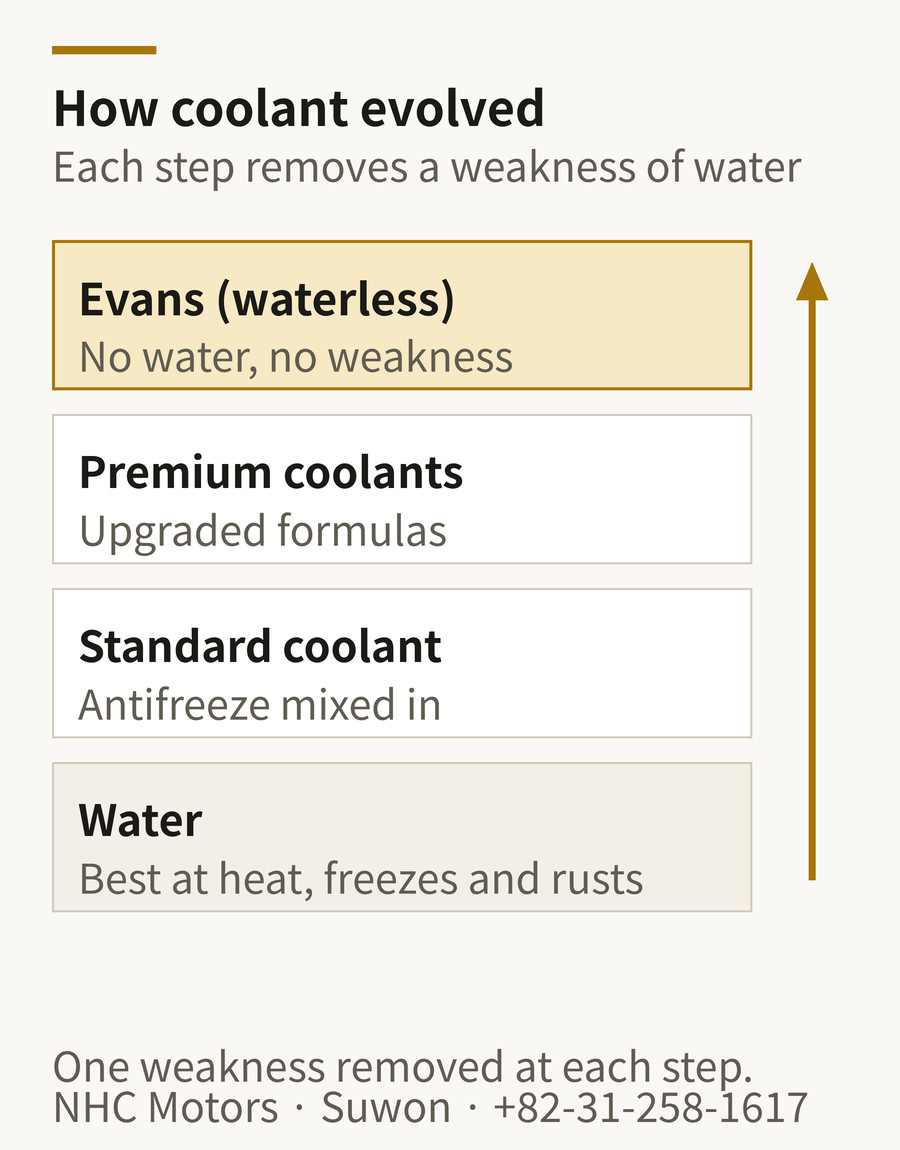
The point of heat management is keeping a car healthy for the long run. What matters more than peak cooling power is not collapsing at the temperatures that damage parts.
These are strengths of Evans. Its high boiling point provides boiling resistance, while its formulation protects against water-related corrosion and pump cavitation. Proper conversion and a healthy cooling system help preserve those characteristics.
The roughly 190°C boiling point at atmospheric pressure provides useful boiling resistance. Conventional coolant boils at different temperatures depending on its mixture and system pressure; water at 100°C is not a direct comparison.
Evans describes reduced cavitation and system pressure as benefits. It still expands when heated: the manufacturer gives a pressure of about 3–5 psig. Let the engine and coolant cool fully before opening the cap, following the vehicle instructions.
The waterless formulation is designed to prevent corrosion and electrolysis. It does not repair worn parts or leaks, so we inspect the cooling lines and components during installation.
The short version — four things.
What actually changes
Installed cars report the same things: less engine noise, less vibration, smoother shifting.
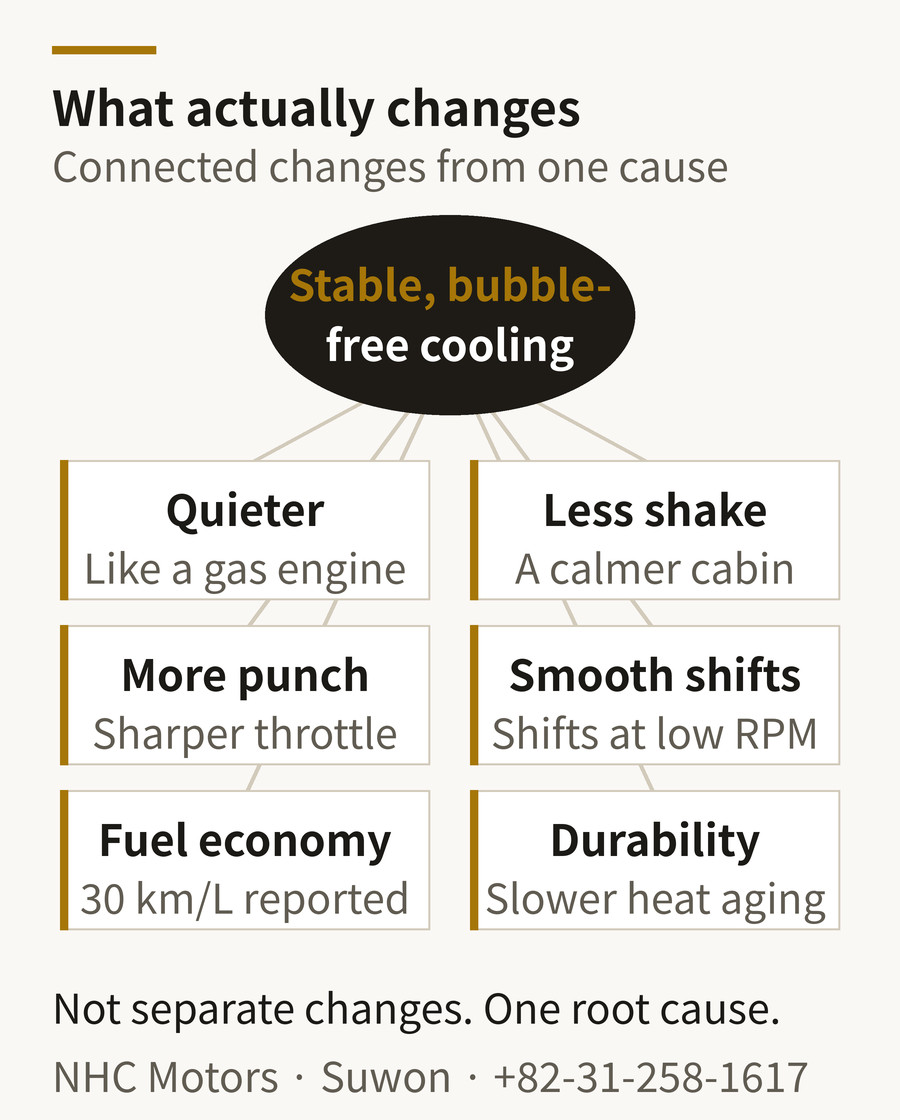
One diesel owner put it this way: "Riding inside, you would not guess it is a diesel." Another owner back-to-back tested a friend's identical car and booked the install on the spot.
An Avante CN7 Hybrid customer sent us a dashboard record of 30.2 km/L. He said it was his seventh reading above 30 km/L.
He is on his third Evans car. Tried it on his first car, did his second, and brought his brand-new third car straight from the dealership.
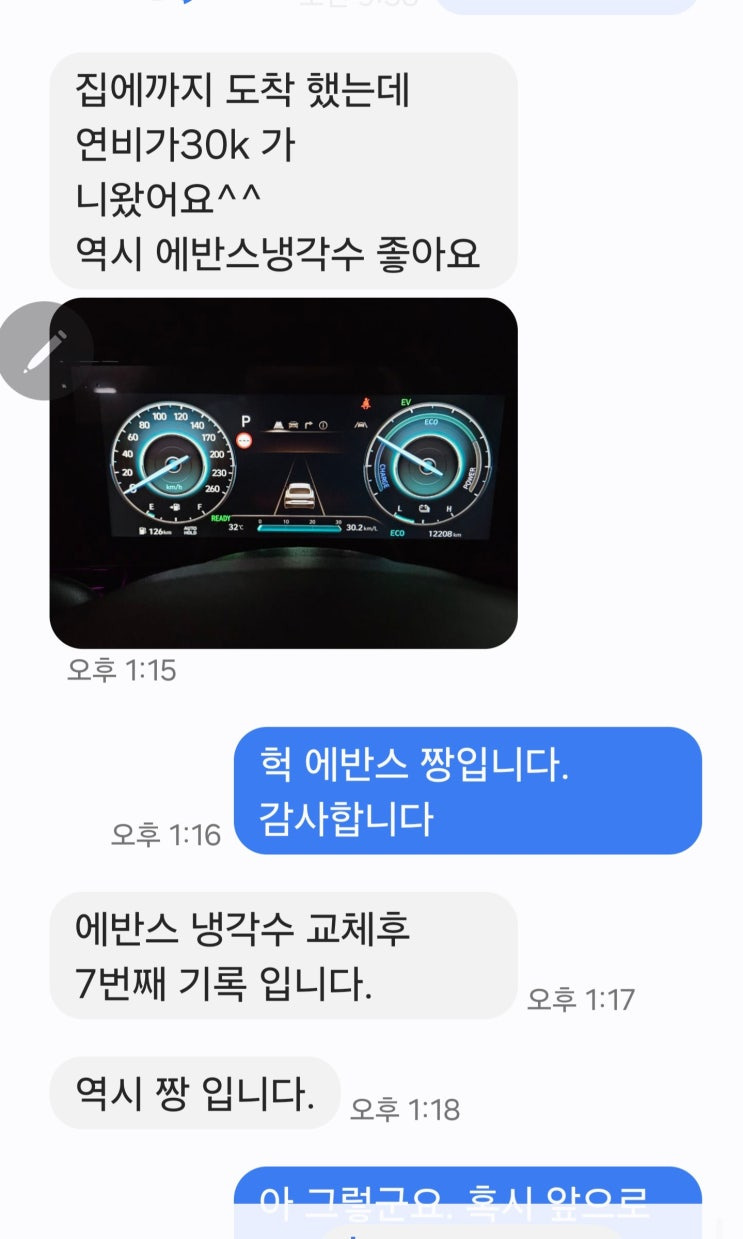
Fuel economy varies with the route, weather and driving habits. This is the customer’s record for that drive, not a controlled before-and-after test of the installation’s effect. The case below shows the actual work and why he chose Evans for his third car.
Avante CN7 Hybrid: the actual installation
See the customer’s 30.2 km/L record, his seventh reading above 30 km/L, and the work photos. This vehicle was also confirmed to have 3% or less residual water after installation.
See the installation and customer record →Hybrids have an extra reason. The engine cycles on and off, so temperature swings constantly — stable cooling is what keeps the engine in its efficiency window.
Durability is a question time will answer. We keep collecting feedback from installed cars, building the data on how much slower leaks and hardening arrive.
Installation decides the result
Evans requires a conversion that manages old coolant and residual water. Final checks matter if the product’s high boiling point and protective characteristics are to be maintained.
Old coolant must be drained thoroughly and any remainder managed. Evans explains that mixing in water or conventional coolant can reduce its high boiling point and protection.
The manufacturer’s ready-for-use threshold is 3% water or less. Above 3%, the boiling point falls and corrosion and cavitation protection may decrease. Testing determines whether further work is needed.
And cooling lines are not simple. Heater lines, thermostats — sections that liquid cannot simply pass through all have to be dried.
We flush, dry and vacuum the system, then fill and circulate the coolant before checking residual water with a refractometer.
None of this was new to us. Long before Evans, our standard coolant service already meant flushing and drying, not drain-and-fill. Evans landed on top of that system — and the two clicked.
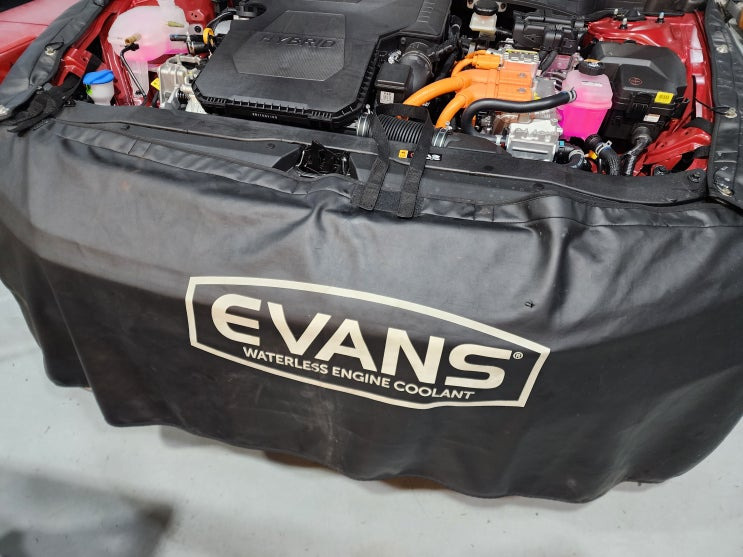
A standard install runs morning to evening in one day; cars with complex lines take two to three. High-displacement cars like a Panamera can need over three days of preparation alone.
Completion depends on the final condition as well as the work involved. Cooling layouts differ, so time alone cannot establish installation quality. We allow the time each vehicle needs and check residual water after circulation.
We worked out per-model procedures across dozens of high-output cars first. So far, not one customer has said they felt no difference.
While the system is open we look at the cooling parts too. Evans is a 100,000–200,000 km decision, so parts that will fail next — water pump, reservoir — are best replaced with genuine parts now.
Product and installation references: Evans High Performance · Evans FAQ (checked 2026-09-12)
The M5 conversion followed cooling-system repairs
We inspect the cooling system before an Evans conversion. Any leaks or component problems need their own repairs. Later visits provide opportunities to check coolant level, leaks and operating condition against the maintenance history.
- BMW M5 — reservoir and thermostat repairs, then ongoing care
The 2024 work included component replacement, cooling-line cleaning and the Evans conversion. Follow-up records continue; the conversion alone is not presented as a repair for leaks or defective components.
Which cars suit it
It fits owners who have decided to keep a car for the long run. Cutting heat stress is the same thing as extending part life.
High-performance cars that run hot, and classics with scarce parts, are also strong candidates. We have installed Evans on 20+ cars, from compact sedans to a 1986 classic and Porsches.
For reference, Koenigsegg — the maker that pushes heat load furthest — is known to fill with waterless coolant from the factory.
There is no such thing as cheap and good, as the saying goes. Evans is like that: big benefits, real cost.
So the owners who choose it mostly fall into three groups: brand-new cars, high-value high-output cars, and keeper classics.
The benefits do not discriminate by car. The choice simply happens where the value is clearest.
Some owners do it on brand-new cars. It preserves a cooling system that has never seen corrosion — breaking the car in without heat stress from day one.
Start with the basics of coolant
What coolant does, the two weaknesses of water, and how to care for it — the first chapter of this story.
Read the coolant guide →FAQ
What is Evans waterless coolant
A glycol-based waterless coolant with a boiling point of about 190°C at atmospheric pressure. Low system pressure and corrosion and cavitation protection are benefits, but thermal expansion still creates pressure. Let the system cool fully before opening the cap, following the vehicle instructions.
Why does the engine get quieter after a coolant change
It is a change we observe repeatedly on installed cars. Our working theory is reduced knock-control intervention, and we keep collecting data. The weaknesses of water and how Evans differs are covered in the article.
Does Evans improve fuel economy
An Avante CN7 Hybrid customer sent a 30.2 km/L dashboard record and reported his seventh reading above 30 km/L. This vehicle finished with 3% or less residual water. It is a customer record, not a controlled before-and-after test of the installation’s effect.
Why is the installation so demanding
Water above 3% can lower the boiling point and protective performance. We drain the old coolant, flush, dry and vacuum, then check residual water with a refractometer after filling and circulation. The manufacturer’s ready-for-use threshold is 3% or less.
How long does an Evans install take
We generally plan a full day; complex cooling layouts can take two to three days. We have also spent over three days on preparation alone for cars such as a Panamera. We explain the schedule for the vehicle and work required, and finish by checking residual water after circulation.
Which cars suit Evans best
Most owners who choose it fall into three groups: brand-new cars, high-value high-output cars, and keeper classics. The benefits apply to any car — we have installed it from compact sedans to supercars — but the value is clearest in those three.
How much does an Evans install cost
Coolant volume and line layout differ by car, so the scope differs too. We quote after seeing the car. Aging cooling parts such as the water pump are often serviced at the same time.
Can I get an Evans install in Suwon, Korea
Yes. NHC Motors in Gwonseon-gu, Suwon has installed Evans on 20+ cars, mostly high-performance. Our own flush-to-verification process applies, and we run appointment-only.
Want to keep your car long? Start with heat
Evans waterless coolant installation and cooling-part service in one visit. NHC Motors, 524 Maesong-gosaek-ro, Gwonseon-gu, Suwon, Korea. Appointment only.
Call +82-31-258-1617 Book on NaverNHC Motors has serviced import and domestic cars in Gwonseon-gu, Suwon for nearly 30 years. Our wheel alignment and total-inspection methods are registered as two Korean patents (No. 10-2552759, No. 10-2646528), with two USPTO applications and two PCT international applications in progress. We hold Korean venture-company certification (innovation growth, first certified 2023, recertified 2026), are registered on the U.S. federal procurement system (SAM.gov), and operate Hunter HawkEye 3D alignment equipment.