Coolant Service, Why It Matters — Heat Management Decides Engine Life
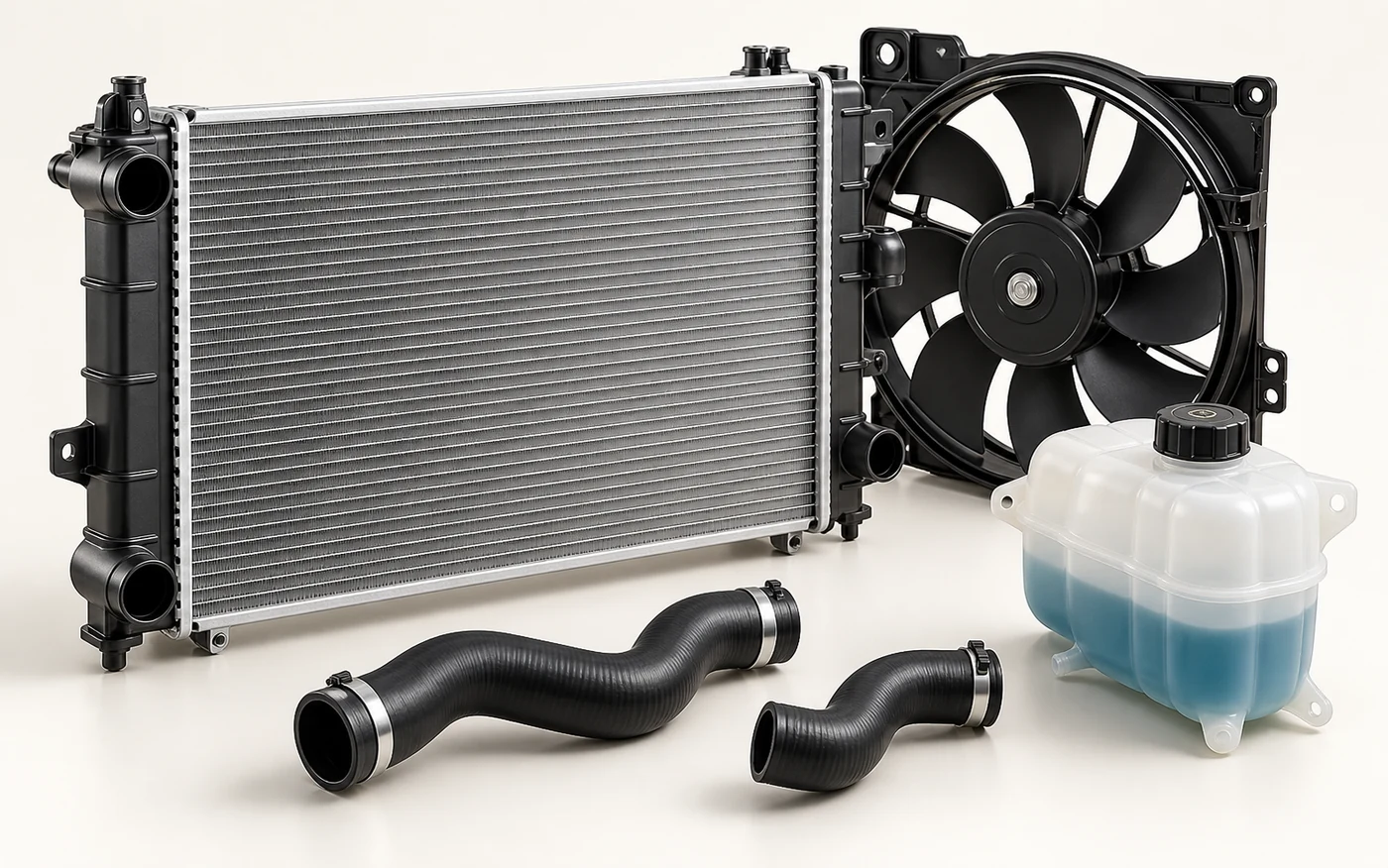
Everyone stays on top of engine oil. Coolant only gets attention when a warning light comes on.
Yet most engine failures start with heat. And coolant is the only liquid in the car that handles it.
Here is what coolant does and how to look after it, in order.
Contents
What coolant does
Coolant picks up heat from the engine and dumps it through the radiator. Its job is to hold the engine around 90°C.
It also carries antifreeze so it will not freeze in winter, and inhibitors that keep the system from rusting.
Boil a pot of noodles dry, and the pot burns and warps. Dunking it in cold water will not bring it back.
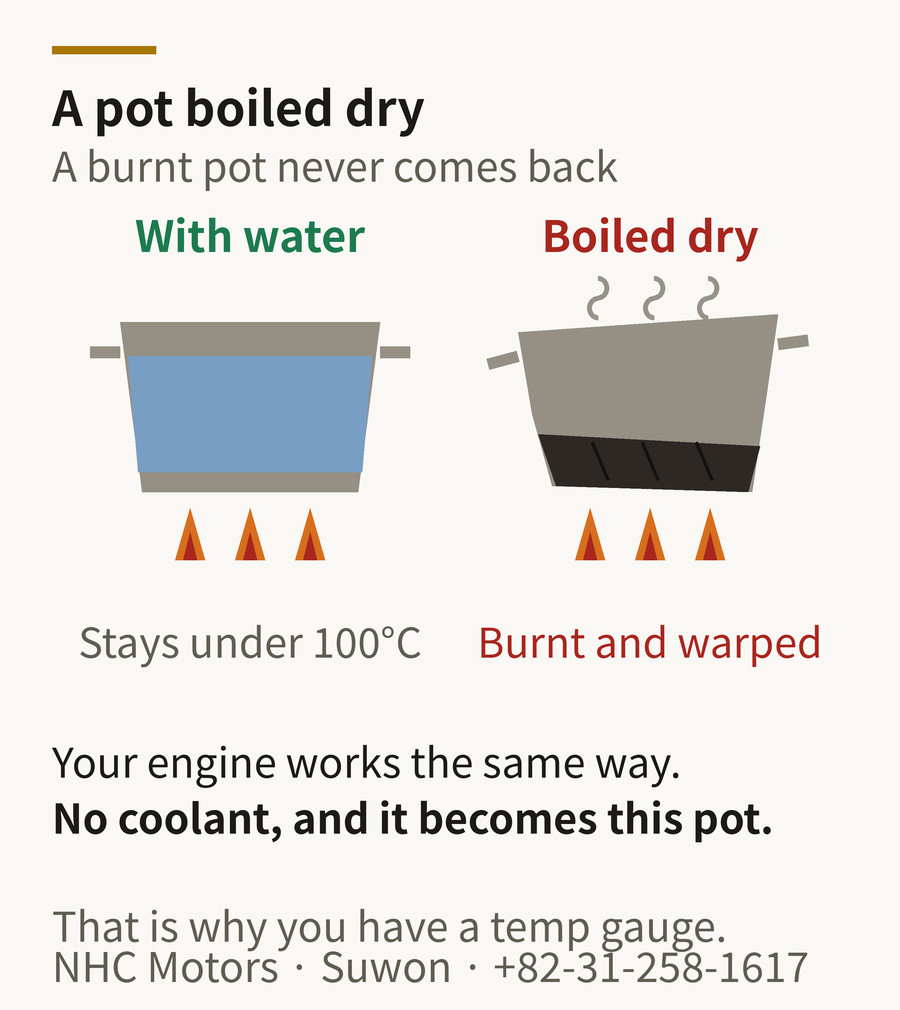
Your engine is no different. Run out of coolant and that block of metal becomes the pot. A warped engine does not come back once it cools.
That is why the dashboard gives coolant its own temperature gauge. It matters enough to earn a spot next to the fuel gauge.
Warning light on? Stop and call
If the temperature gauge spikes or the coolant warning comes on while driving, our advice is simple. Pull over and have the car towed.
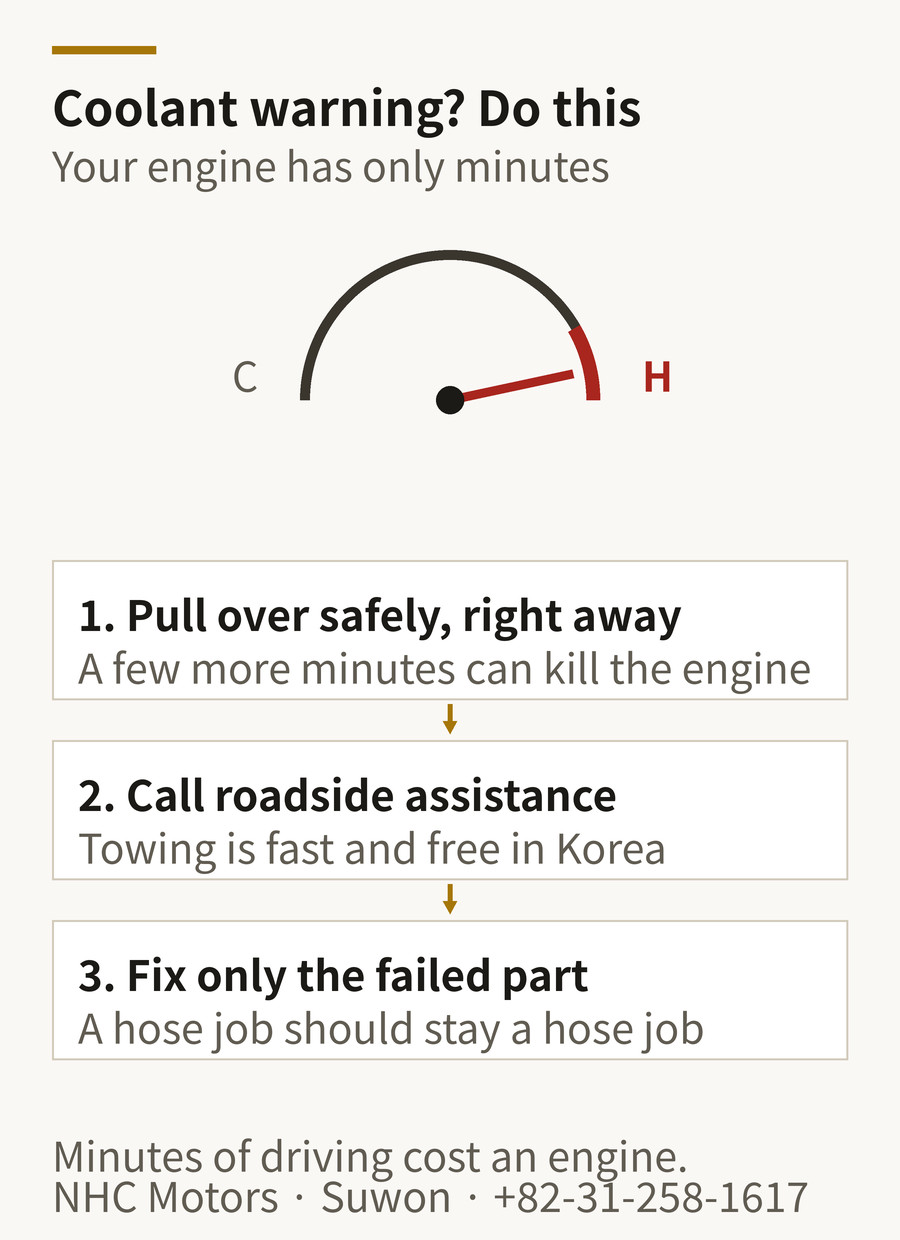
In Korea, roadside assistance and towing are fast and free through your insurer. This is not rural America where the next shop is hours away. There is no reason to carry engine-loss risk for a few minutes of driving.
Cooling lines run all through the car, and with age a small hose will eventually let go. Replace the hose and the story ends there.
But we see cars where a late reaction turned it into engine repair. Not hours late — minutes. A hose-sized problem became an engine-sized bill.
Heat ages your parts
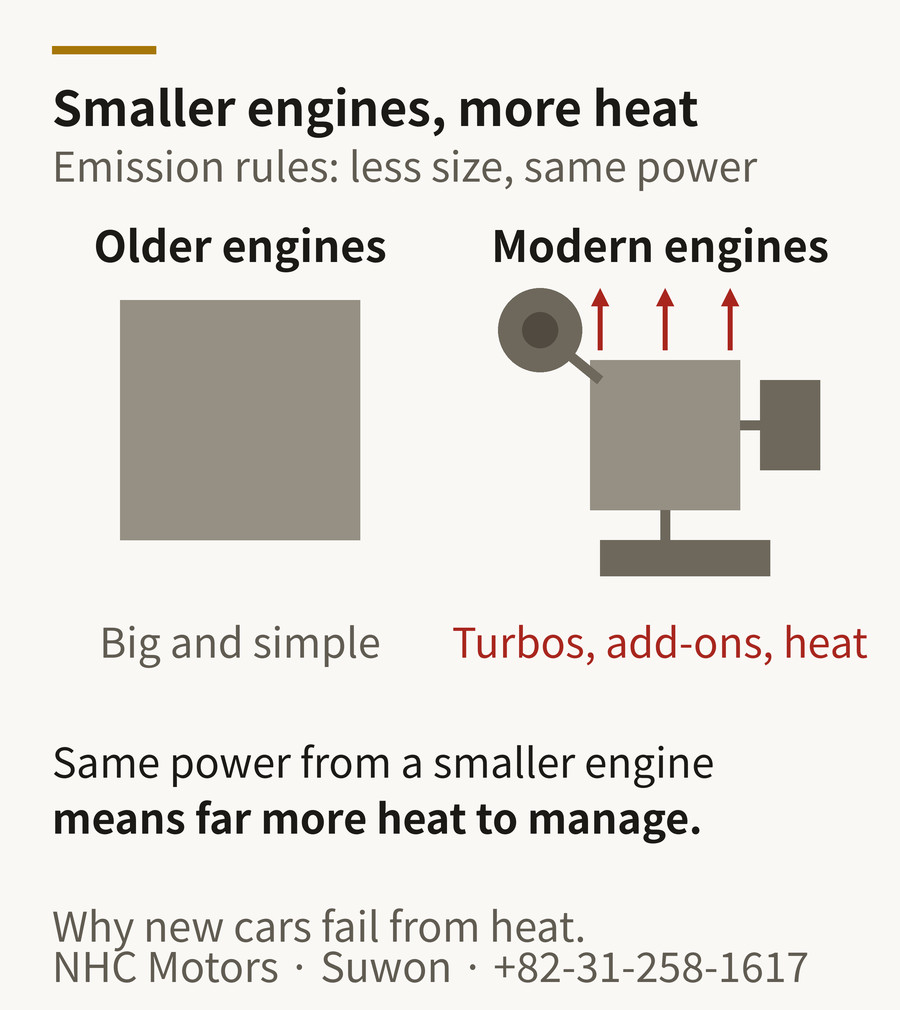
Modern engines are smaller and stronger. Emission rules force displacement down while output has to stay.
So turbochargers and add-ons pile on, and there is far more heat to manage. That is why heat-related failures have become common on newer cars.
Parts feel the heat first. Gaskets and rubber harden and crack, and the additives in engine oil break down early.
This is why well-maintained cars still develop oil leaks. Oil filter housing, cam retainer, oil pan — the leak point differs, but the starting point is usually heat.
That is why we treat heat management as the starting point of all maintenance. Coolant sits at the center of it.
Why not just use water
Judged purely on moving heat, pure water is the best fluid there is.
Yet nobody runs an engine on water alone. It freezes in winter, builds scale, and rusts the lines.
So we trade away a little cooling power and mix in antifreeze — that trade is the coolant we use today. Four-season stability over peak cooling.
Even with antifreeze, two weaknesses remain. These are the two we actually see in the workshop.
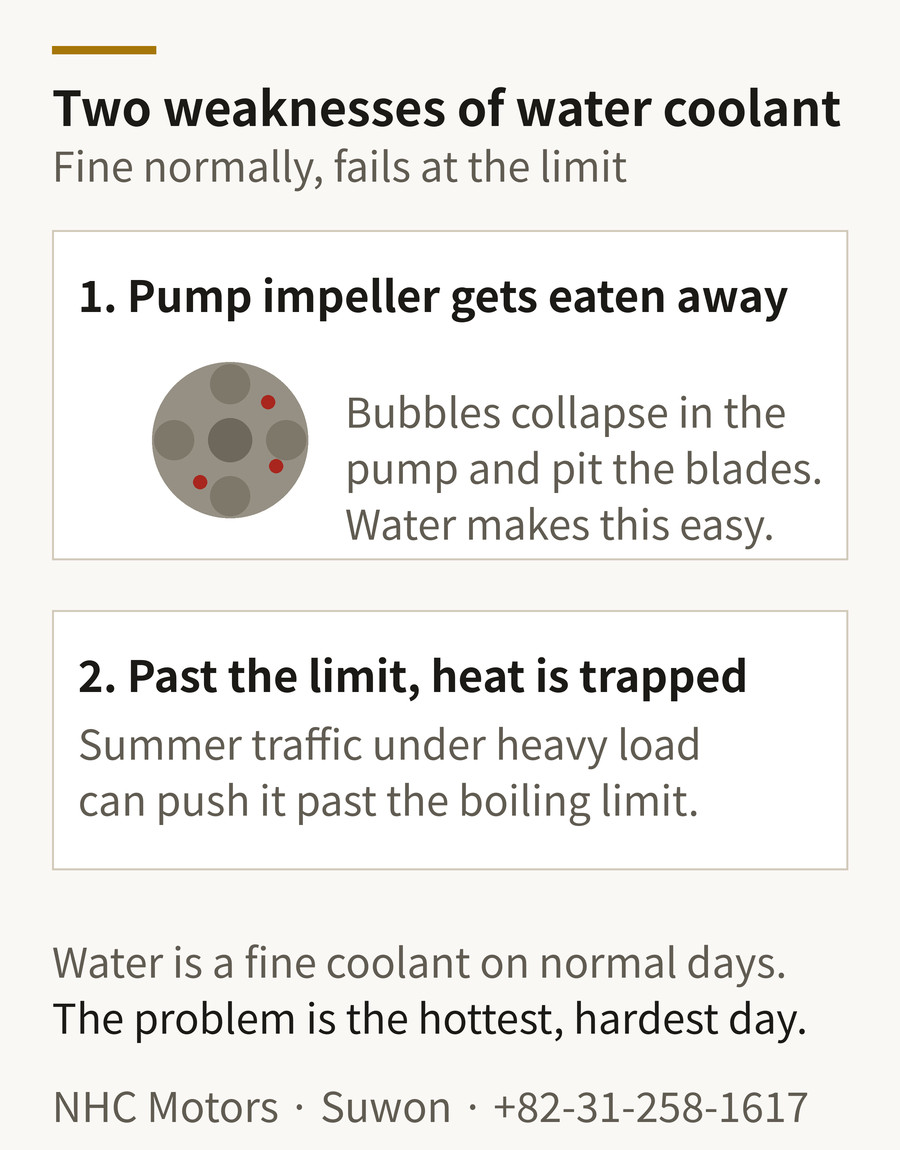
One is the water pump. In the pump's low-pressure zone, bubbles form and collapse — cavitation — and the shock pits the impeller. Water's high vapor pressure makes this condition easy to reach. Open up an old pump and you can see the pitting.
The other is the limit situation. Heavy load in stop-and-go summer traffic can push past the boiling limit, and suddenly heat stops leaving the engine.
If a bubble film forms at a hot spot like the cylinder head, it blocks heat transfer and can end in overheating. Fine all year, then it fails on the hottest day.
Cooling parts wear out too
Coolant is not the only thing that ages. The parts that carry it age with it.
Water pumps and thermal management modules leak on gasoline and diesel cars alike. We have seen reservoirs that looked fine from above but were seeping at the seams once removed.
Nearly-new cars come in with cooling failures as well. Some models, like BMW G-body cars, had frequent cooling issues even under warranty, and we have replaced a burst cooling circuit on a performance sedan with under 20,000 km.
The car body stayed the same size while the engine got smaller and hotter — the cooling system carries that extra burden.
So when major cooling work is planned, we recommend replacing the parts that will fail next with genuine parts at the same time. It is cheaper than opening the system twice.
Condition over mileage
Change intervals differ by manufacturer and coolant type, so the manual comes first.
G63 cooling-system care after an overheating warning history →
But we look at condition over mileage. Drain an old system and some cars give up plaque-like sediment and floating white flakes. In that state the coolant needs changing regardless of the interval.
And one more thing: how the coolant is changed matters more than changing it. Drain-and-fill leaves the scale and sediment sitting in the lines.
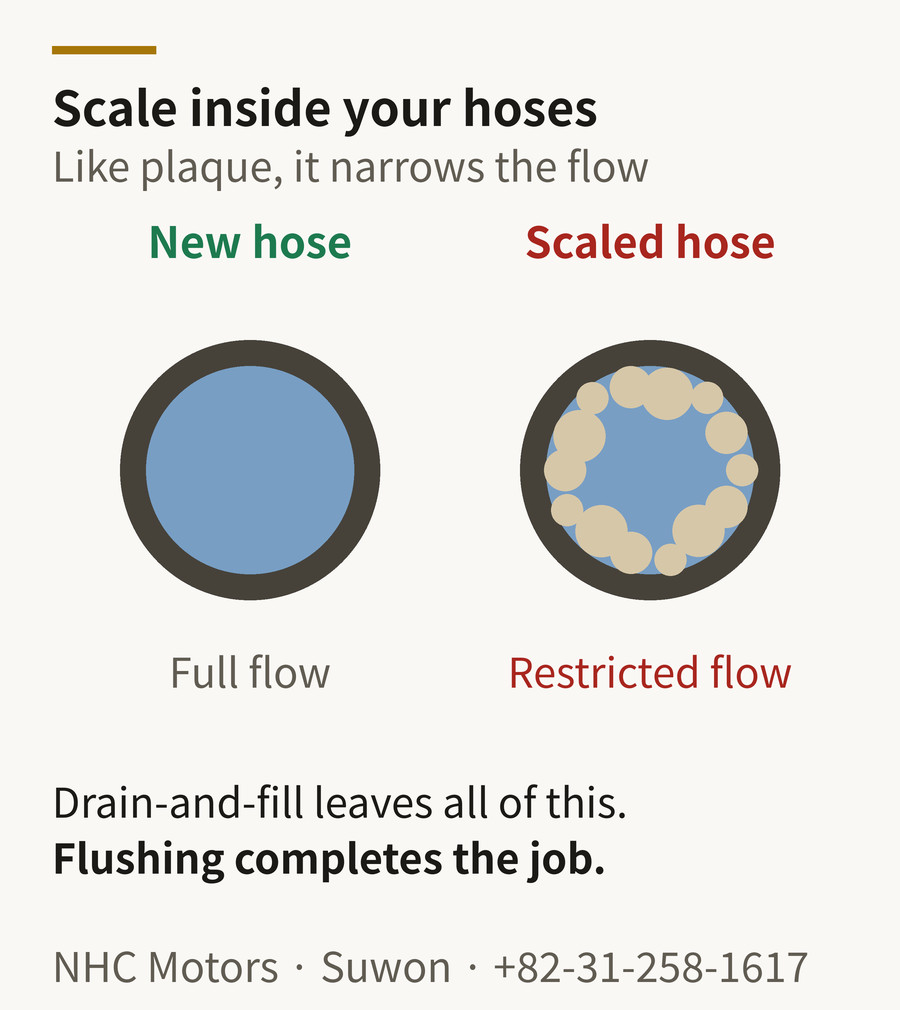
Scale is a problem because it traps heat. The passage narrows, and scale on the walls works like a blanket. Even with fresh coolant, cooling capacity is already down.
The engine then runs hot. The computer pulls power and burns more fuel — less performance, worse economy, at the same time.
So we flush the debris out before filling. We believe this is why so many customers report better economy and response after a coolant service here.
Top up with the same specification only. Mixed formulas can react and form sediment.
Coolant is water-based, so it slowly loses volume over time. But a visible drop means a leak somewhere. Low coolant leads straight to overheating, so do not sit on the signs.
That is why we check coolant level and condition at every oil change (6 months or 10,000 km). An oil change is not just an oil swap — it is the car's basic mini-inspection.
Basics before tuning
Plenty of owners thinking about tuning or ECU mapping ask us where to start. Our answer: basics first. And the first line of the basics is cooling.
When cooling wavers, the computer keeps pulling power back. Whatever you add on top will not deliver.

Get the coolant side right first, then add power. It ends up cheaper and far more satisfying. Curious where your car stands? Our Total Inspection covers the cooling system end to end.
One level above
Everything above is the baseline of coolant care. Follow it and half of heat management is done.
But if you plan to keep a car long, or you drive something that runs hot, there is one level above: waterless coolant, with the water removed entirely.
Our coolant-service system came first. Flushing and drying were already established here when we met Evans — and the two clicked.
The Evans story deserves its own space, so we covered our 20-plus installs in a separate guide.
Special care — Evans waterless coolant
A 190°C boiling point and no bubbles to the limit. What makes it different, and why installation quality decides everything.
Read the Evans guide →Check coolant loss before deciding on a fluid change
Topping up or changing coolant does not establish why its level has fallen. We check the location of the traces and recent repair history, and distinguish component repairs from a coolant change or conversion.
- BMW 320d GT — borescope inspection of coolant traces
With the reservoir empty, we inspected around the oil-filter housing using a borescope. The traces alone did not establish an active leak; further inspection and level monitoring were advised.
- BMW M5 — cooling-system repairs and Evans conversion in 2024
The reservoir and thermostat were replaced, followed by cooling-line cleaning and an Evans conversion. Subsequent condition is being tracked through regular maintenance.
FAQ
What does coolant actually do
It carries heat from the engine to the radiator and keeps the engine around 90°C. It also contains antifreeze so it will not freeze, and inhibitors that prevent rust.
How often should coolant be changed
Manufacturer intervals vary by car and coolant type, so the manual comes first. We look at condition rather than mileage: if the coolant is cloudy or carries sediment, we recommend changing it even before the interval.
Can I mix coolants of different colors
We advise against it. Different formulas can react and form sediment. Top up with the same specification, and if you do not know what is in the system, a full change is the safe route.
How do I spot a coolant leak
Coolant dropping without topping up is the first sign. Marks on the ground, dried stains at the reservoir seams, and a sweet smell are others. Some slow leaks are invisible from above and only show when parts come off during inspection.
When should the water pump be replaced
When it starts leaking or making noise. Old pumps often show impellers pitted by cavitation. If major cooling work is planned, replacing the pump at the same time saves labor.
What is Evans waterless coolant
A coolant that contains no water. With a boiling point around 190°C it holds to the limit without bubbles, and with no water there is no corrosion. We cover it in a separate guide.
What should I do when the coolant warning comes on
Pull over safely and have the car towed. In Korea towing service is fast and free through insurers, so there is no reason to risk the engine for a few more minutes of driving.
When should the coolant be checked
We check coolant level and condition at every engine oil change (6 months or 10,000 km). An oil change is the basic mini-inspection of the car, not just an oil swap.
Can I get cooling system service in Suwon, Korea
Yes. NHC Motors in Gwonseon-gu, Suwon checks coolant condition, finds leaks, and services cooling parts such as water pumps and reservoirs. Genuine parts are recommended. Appointment only.
Start with your coolant's condition
Coolant condition check, leak inspection, and cooling-part service in one visit. NHC Motors, 524 Maesong-gosaek-ro, Gwonseon-gu, Suwon, Korea. Appointment only.
Call +82-31-258-1617 Book on NaverNHC Motors has serviced import and domestic cars in Gwonseon-gu, Suwon for nearly 30 years. Our wheel alignment and total-inspection methods are registered as two Korean patents (No. 10-2552759, No. 10-2646528), with two USPTO applications and two PCT international applications in progress. We hold Korean venture-company certification (innovation growth, first certified 2023, recertified 2026), are registered on the U.S. federal procurement system (SAM.gov), and operate Hunter HawkEye 3D alignment equipment.