NHC MOTORS · 정비사례
Hyundai Veloster JS: refining ride comfort after a satisfying alignment service
Satisfied with the September alignment and Road Force service, the customer returned to further refine the suspension, wheels and tires.
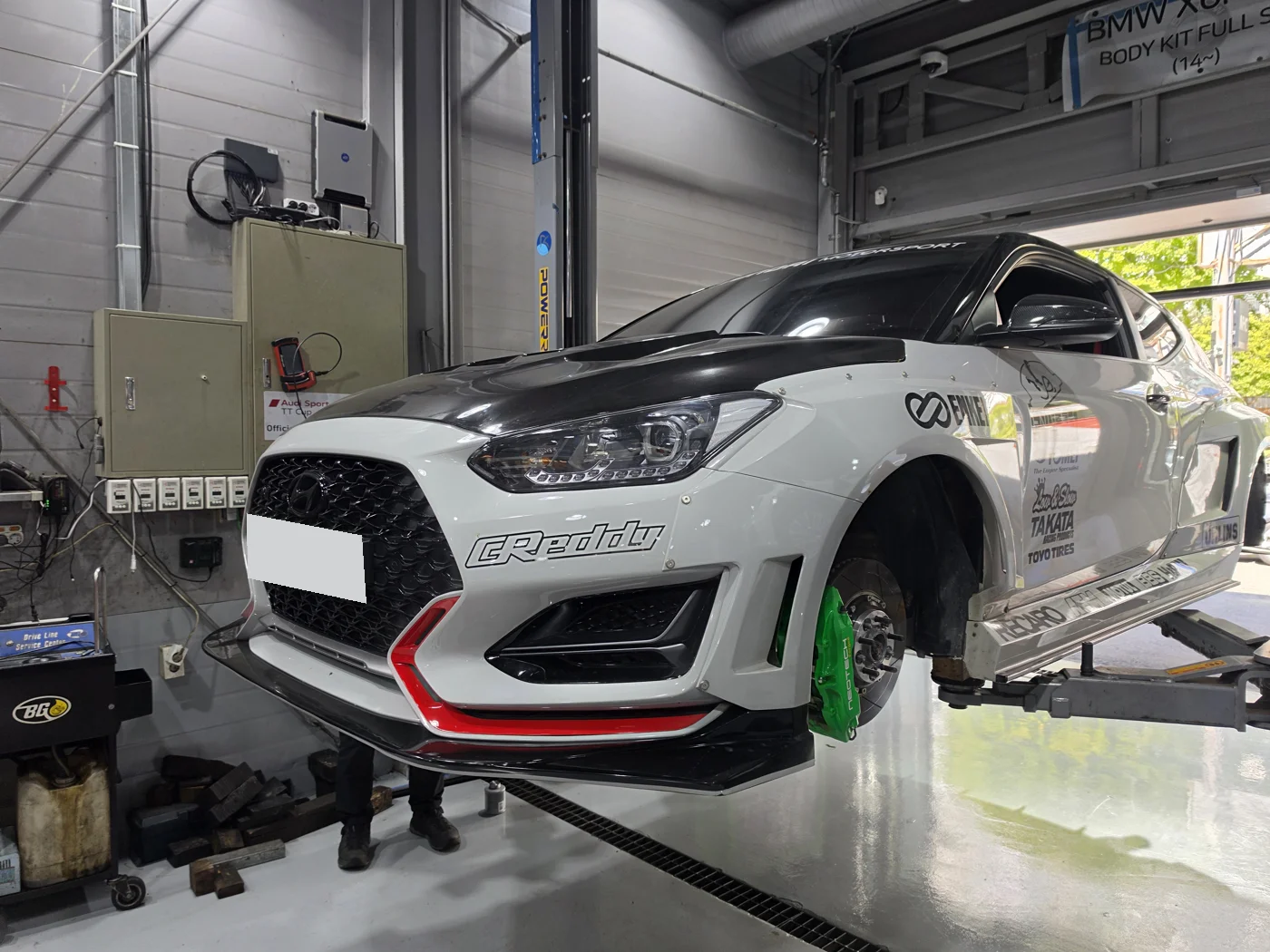
This 2019 Veloster JS had alignment and Road Force work on 17 September. Satisfied with that service, the customer returned on 6–8 October 2026 to further refine the suspension, wheels and tires. The additional work extended to suspension setup, wheels, tires and steering components. Mileage at completion was 168,608km.
Reason for returning and the September work
Before the September work, the customer described the modified car as “too difficult to drive.” After the September service, the customer was satisfied and chose to have additional areas refined.
The September work included a ride-height adjustment prioritizing stability, improved lane-change and cornering behavior and reduced some road noise. The customer was satisfied with the result. The October visit expanded the work beyond the previous scope to further refine the car, including ride comfort.
Suspension work
Measured clearance and hardware work
Before adjustment · measured droop
Work performed · component dimensions
Front damper extension and rear adapter dimensions are shown separately from the pre-adjustment wheel droop.
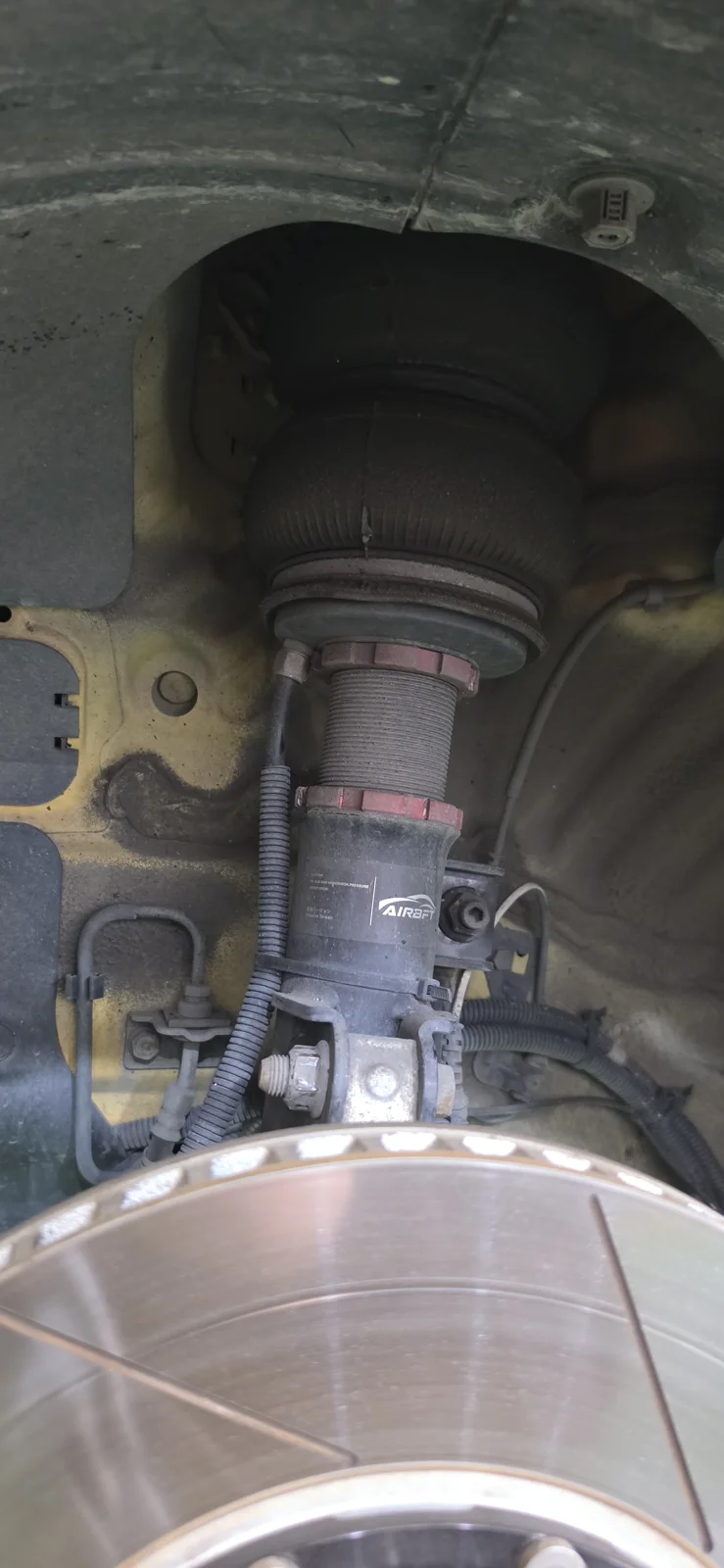
Pre-adjustment droop clearance was 18–20mm at the front and 7–9mm at the rear. Droop clearance is the additional downward wheel travel available from the standing ride height. Raising the air setting provided clearance but also raised the car, so the damper and air-spring operating positions were revised.
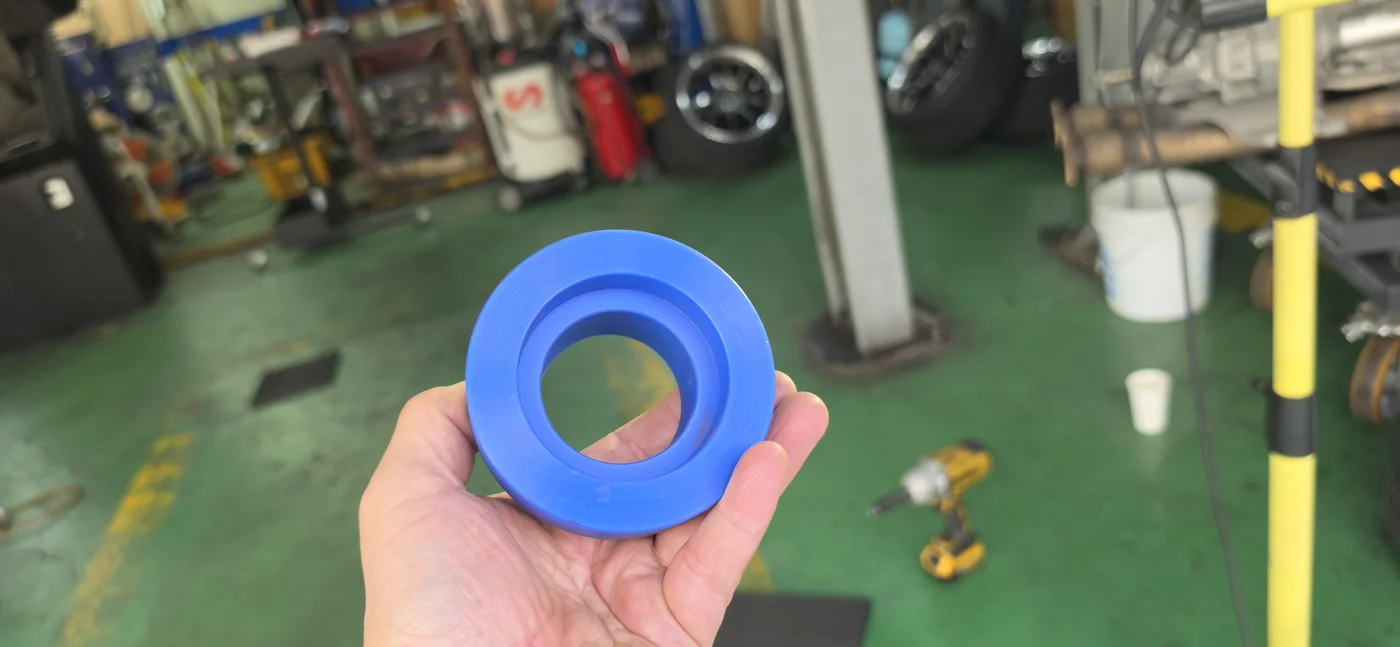
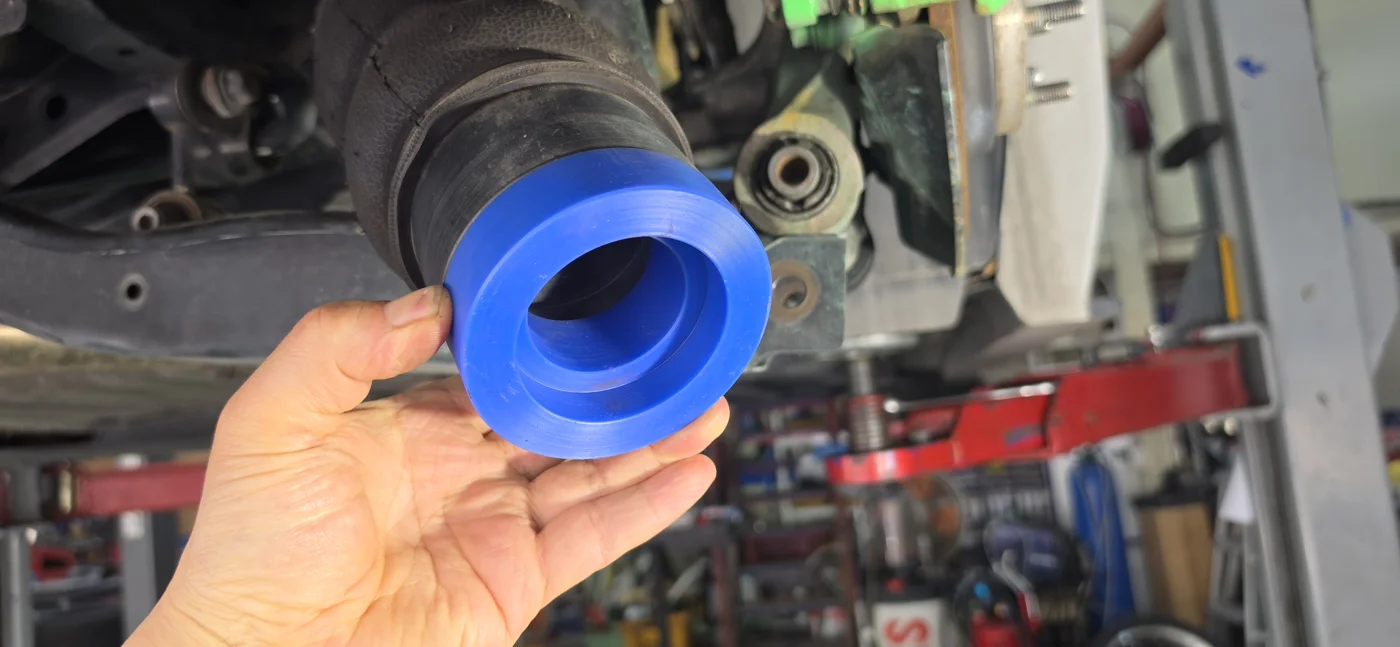
Front damper maximum extension was increased by approximately 25mm. A 25mm lower air-spring adapter was fitted at the rear and rear shock length was reset. Bushings were retightened with the vehicle loaded at ride height. Damping was set three clicks softer at the front and four clicks softer at the rear.
The Korean guide to suspension noise and loaded bushing tightening explains why bonded rubber bushings are tightened at the normal ride height. The Short below shows this process on a Mercedes-Benz GLS500.
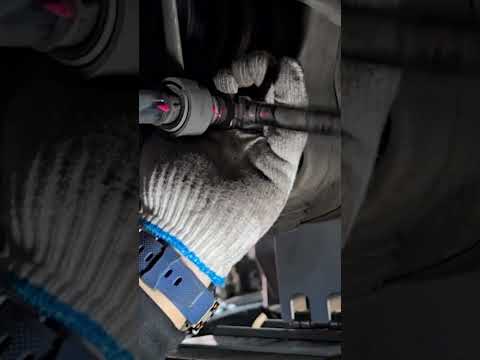 Watch the loaded bushing tightening Short →
Wheels, tires and steering components
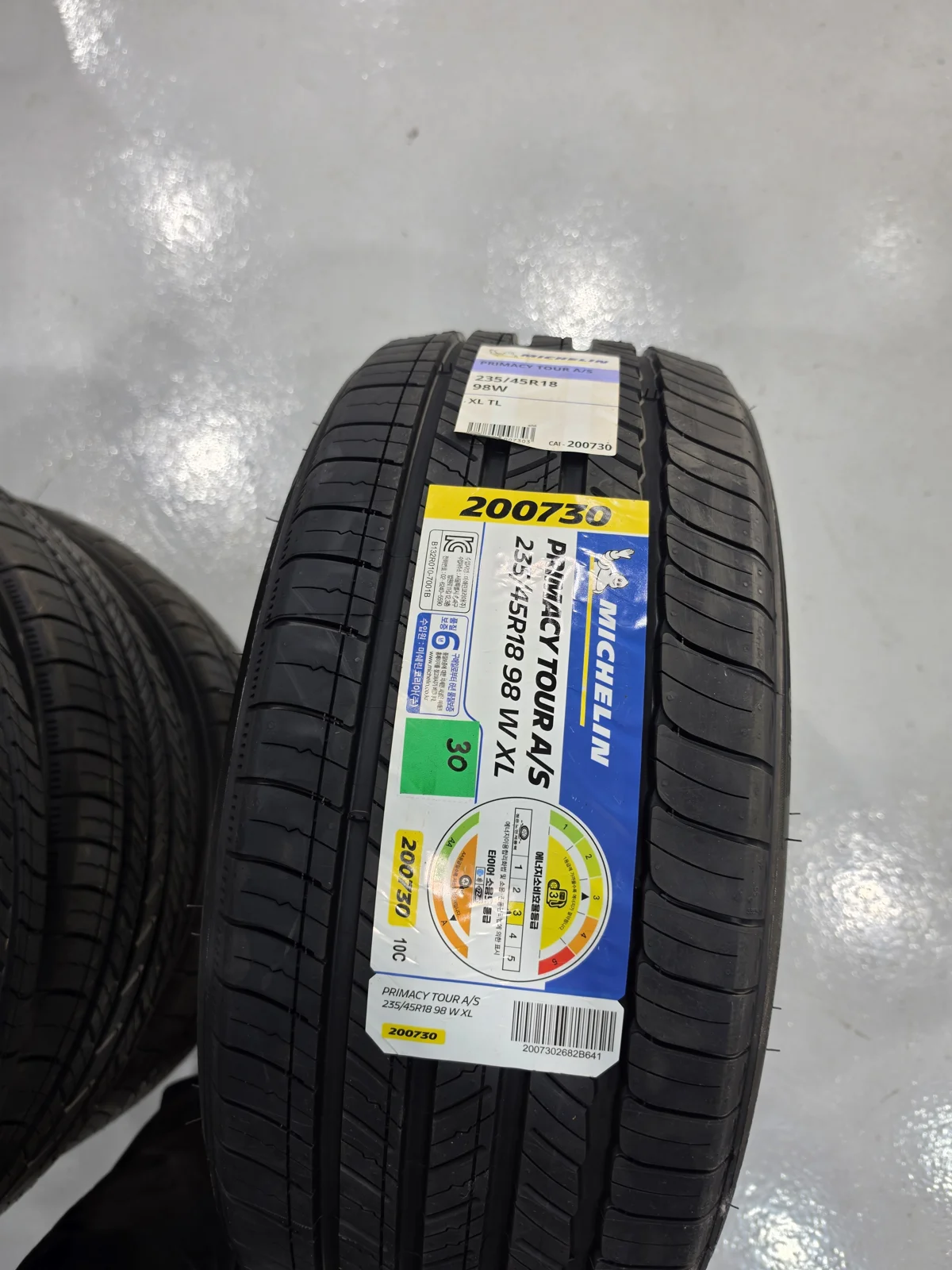
A trial with 245/45R18 tires was acceptable in straight-line driving but caused wheelhouse/bodykit interference during a U-turn. The final setup used 9J ET20 wheels, Michelin Primacy Tour A/S 235/45R18 tires and 15mm hub spacers front and rear.
Sidewall height by tire size
265 × 0.35 =92.75mm / 235 × 0.45 =105.75mm.
Sidewall height by tire size changed from 92.75mm to 105.75mm, an increase of 13mm.
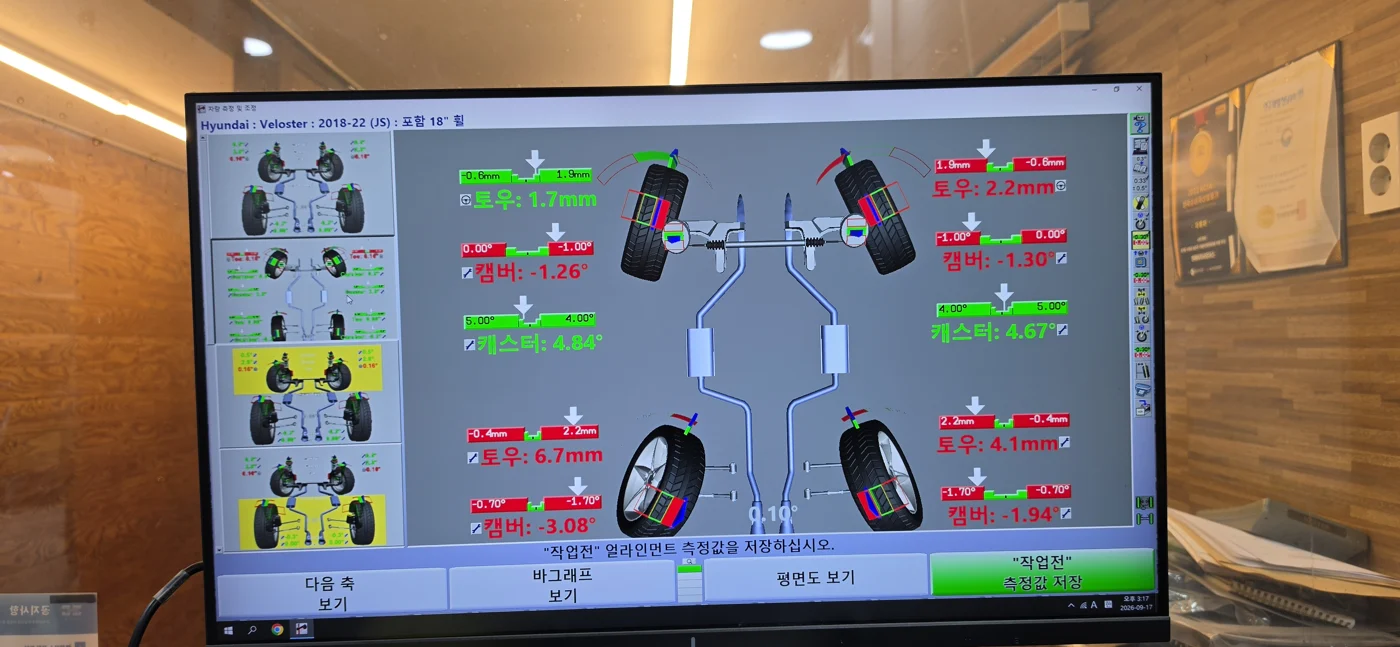
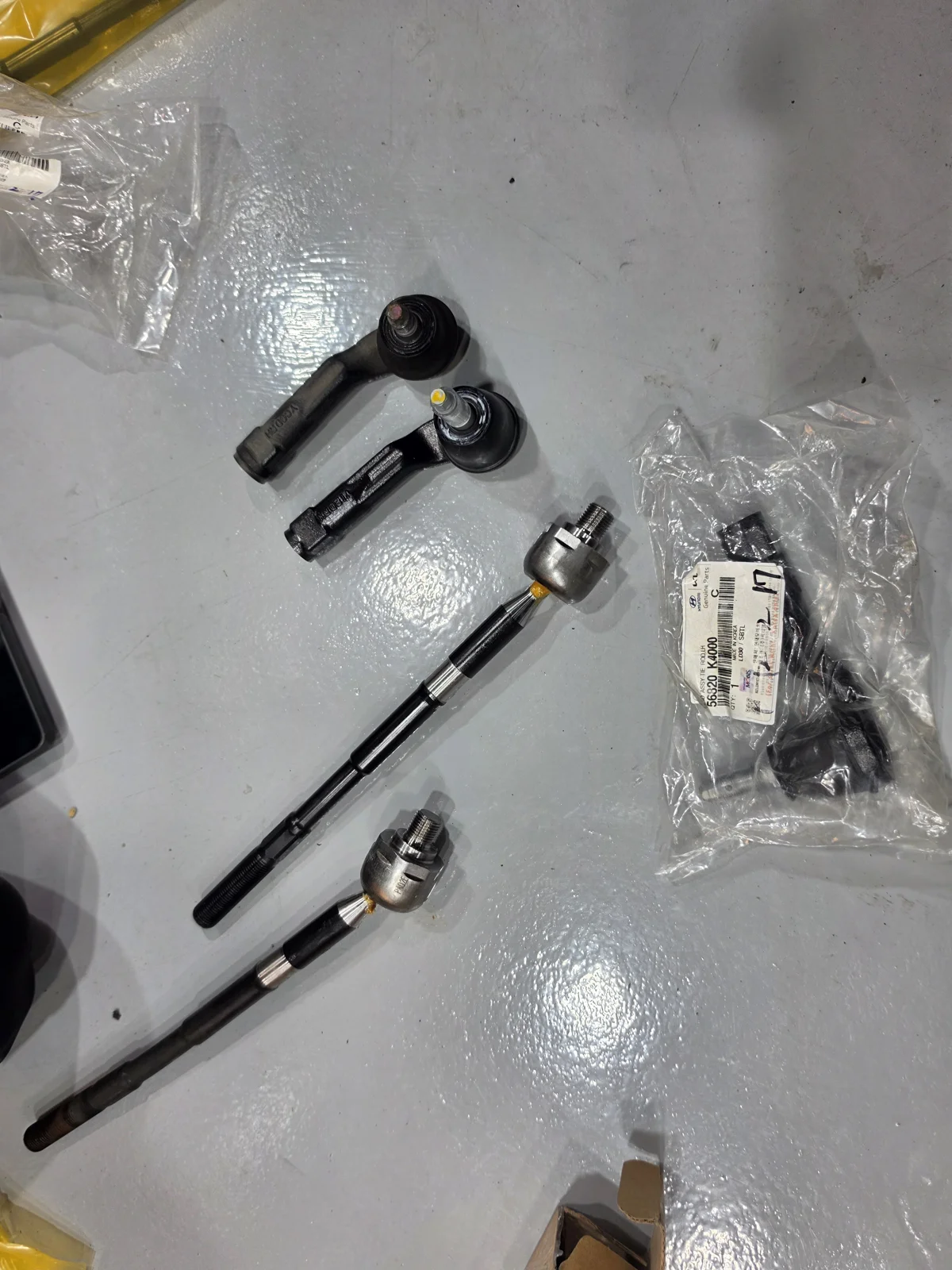
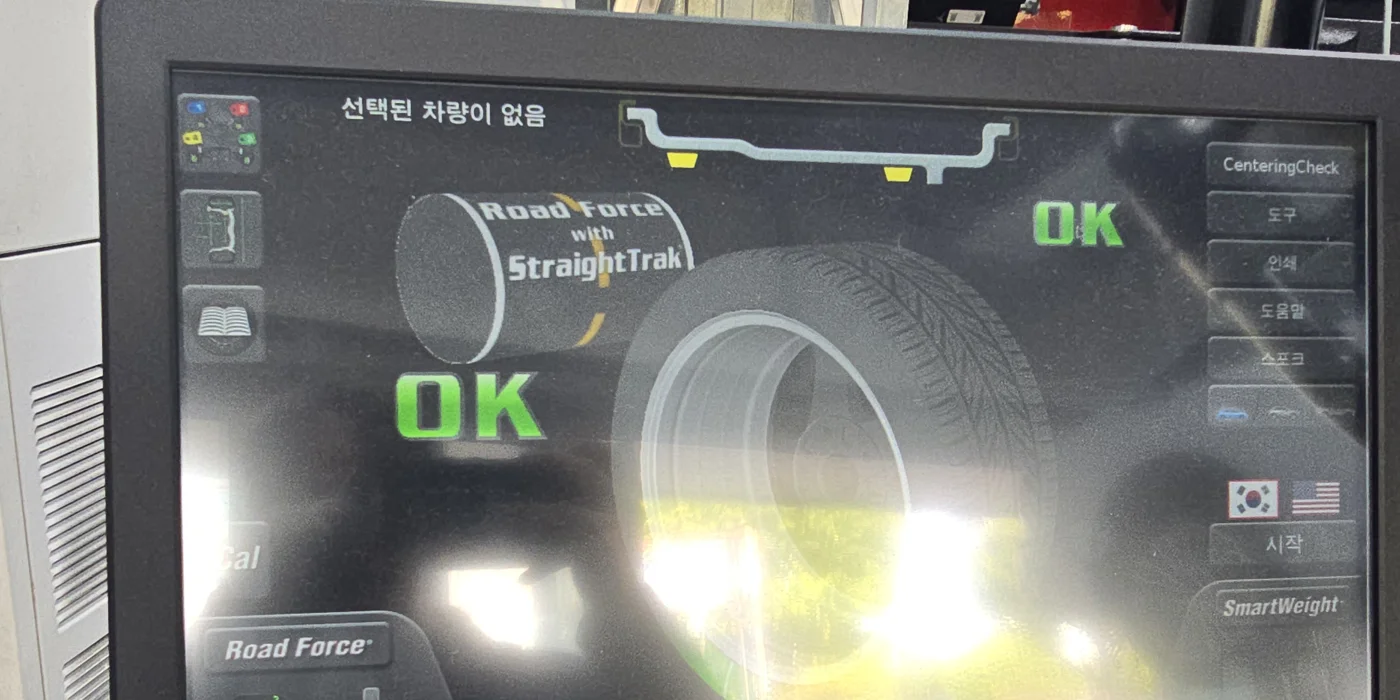
Both outer tie-rod ends and two inner ball joints were replaced in October. Four-wheel alignment and Road Force work were carried out for the revised suspension and wheel/tire setup.
Alignment at three stages
The three stages are the first September intake, after the September alignment and the October final setting. Suspension, wheels and tires were also changed in October.
Four corners, three measured stages
① 17 Sep intake → ② 17 Sep after → ③ 8 Oct final
Toe · mm
FRONT OF CAR ↑
Front left
Front right
Rear left
Rear right
Camber · °
FRONT OF CAR ↑
Front left
Front right
Rear left
Rear right
September intake → after September alignment → October final setup. Suspension, wheels and tires were also changed in October.
View all measured values
| Item | 17 Sep intake | 17 Sep after | 8 Oct final |
|---|---|---|---|
| Front left toe | 1.7mm | 0.6mm | 0.6mm |
| Front right toe | 2.2mm | 0.6mm | 0.5mm |
| Rear left toe | 6.7mm | 1.3mm | 1.1mm |
| Rear right toe | 4.1mm | 1.5mm | 1.3mm |
| Front left camber | -1.26° | -1.79° | -1.38° |
| Front right camber | -1.30° | -1.59° | -1.55° |
| Rear left camber | -3.08° | -1.87° | -1.58° |
| Rear right camber | -1.94° | -1.82° | -1.51° |
| Thrust angle | 0.10° | -0.01° | -0.01° |
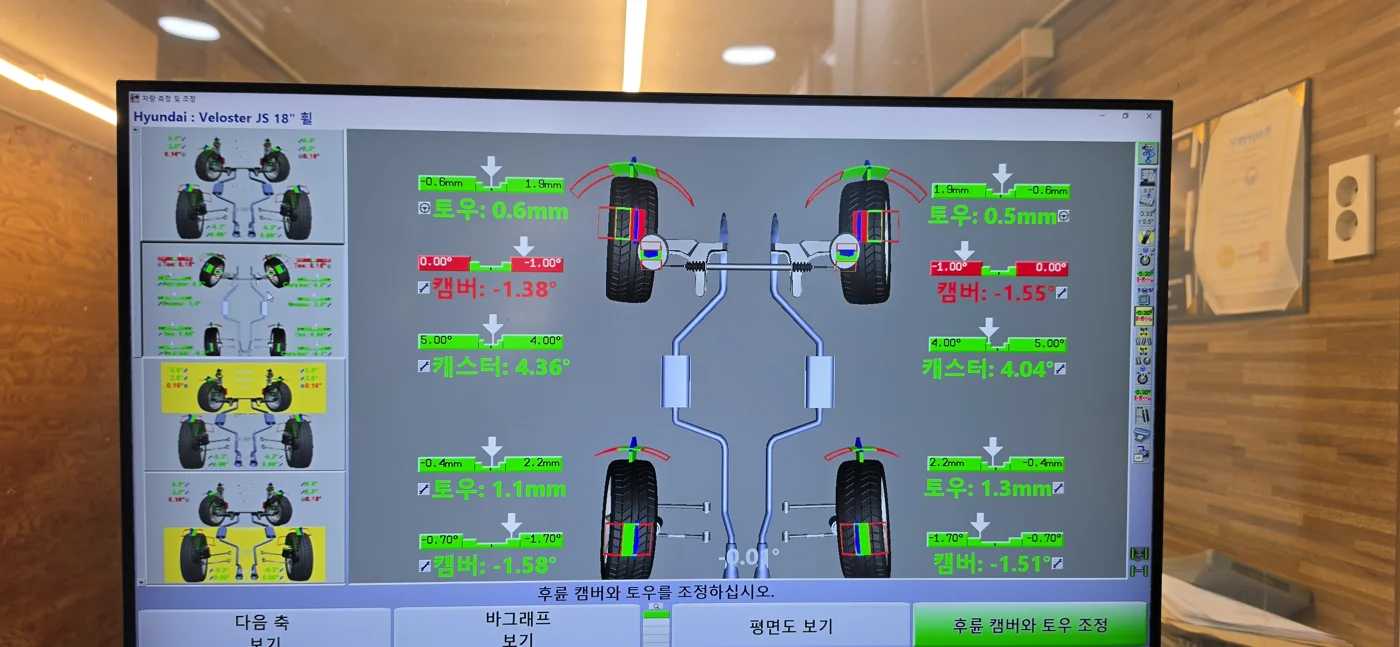
Final front caster was 4.36° left and 4.04° right. Rear toe and camber were within the displayed equipment database ranges. Front camber of -1.38° and -1.55° was a custom setting outside the displayed original specification range. Thrust angle was -0.01° after both visits.
Comparison road tests and trial tires
- Compare the existing and trial tire setups on road tests and adjust ride height.
- Exclude four trial 245/45R18 tires from the final setup after U-turn interference.
Suspension operating-position adjustments
- Extend front damper maximum length by about 25mm.
- Fit a 25mm lower rear air-spring adapter.
- Reset rear shock length so the lower bolt enters without force at full droop.
- Fabricate the rear air-suspension mount.
Final wheels and tires
- Use 9J ET20 wheels in the final setup.
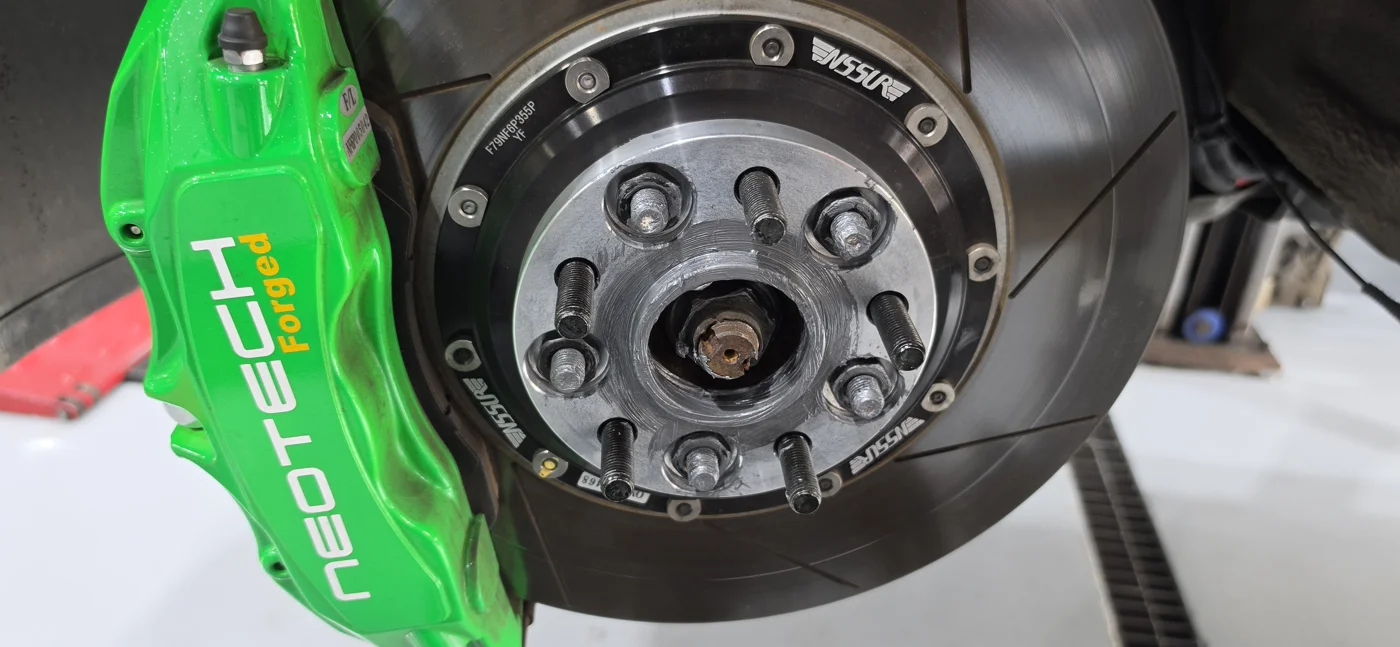
- Fit 15mm front and rear hub spacers.
- Fit four Michelin PRIMACY TOUR A/S 235/45R18 98W XL tires as the final selection.
Steering-component replacement
- Replace one outer tie-rod end on each side.
- Replace two inner ball joints.
Loaded tightening, damping and surrounding checks
- Release and retighten bushings at loaded ride height.
- Soften damping by three front and four rear clicks from the previous settings.
- Check stabilizer-link length.
- Check maximum shock extension and allowable air-spring extension.
- Check brake-hose tension and bump-stop clearance.
Final alignment, electronic setting and road testing
- Perform Hunter four-wheel alignment for the revised ride height, wheels and tires.
- Complete the Codelink setting.
- Perform Hunter ROAD FORCE work on both trial and final tire setups.
- After the technician road test, verify high-speed, cornering, successive bends and bump response on a customer ride-along.
Customer satisfaction and changes after the work
After the work, the owner of NHC road-tested the car and then drove with the customer. High-speed straight-line behavior, cornering and successive bends were more stable, and bump impacts were reduced compared with before. The customer was satisfied with the improved ride.
Discuss ride comfort and handling after modifications
Tell us your wheel and tire sizes, suspension changes and the driving conditions that feel uncomfortable. We explain the required inspection, work scope and estimate before proceeding with your agreement.
Questions
What was added after the September service?
The suspension, wheels and tires were refined further. Steering components were replaced, followed by loaded bushing tightening, damping adjustments and final alignment.
Which components changed by 25mm?
Front damper maximum extension was increased by about 25mm. A 25mm lower rear air-spring adapter was fitted and rear shock length was reset.
How were the final tires selected?
Trial 245/45R18 tires caused U-turn interference. The final selection was four Michelin PRIMACY TOUR A/S 235/45R18 98W XL tires.
How was the final alignment set?
Rear toe and camber were set within the equipment reference ranges. Front camber was a custom setting for the changed ride height, wheels and tires.
Discuss ride comfort and handling after modifications
Tell us your wheel and tire sizes, suspension changes and the driving conditions that feel uncomfortable. We explain the required inspection, work scope and estimate before proceeding with your agreement.
We explain the scope of any repairs and the estimate before proceeding with your approval.
Call 031-258-1617Book on NaverBy appointment only · Gwonseon-gu, Suwon
Total inspection scope and booking information (Korean)