Still Pulling After Alignment
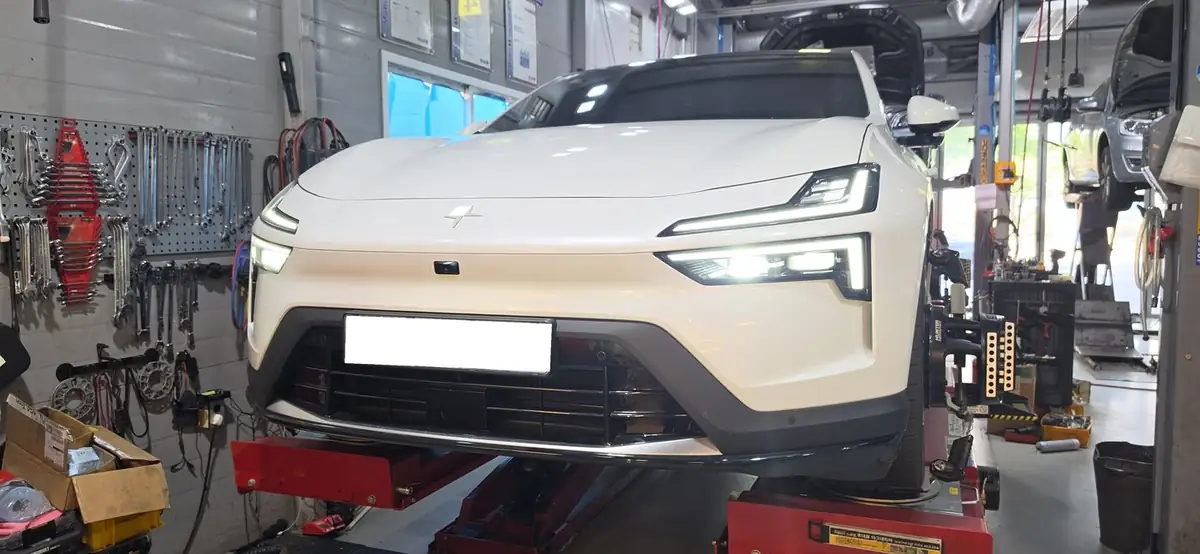
This guide covers checks when a vehicle still pulls after alignment. Compare the previous alignment report with tire and suspension condition before choosing further work.
You changed the tires. You had the alignment set several times. And the car still pulls to one side. When that happens, the cause may not be the alignment at all.
Contents
A pull has more than one cause
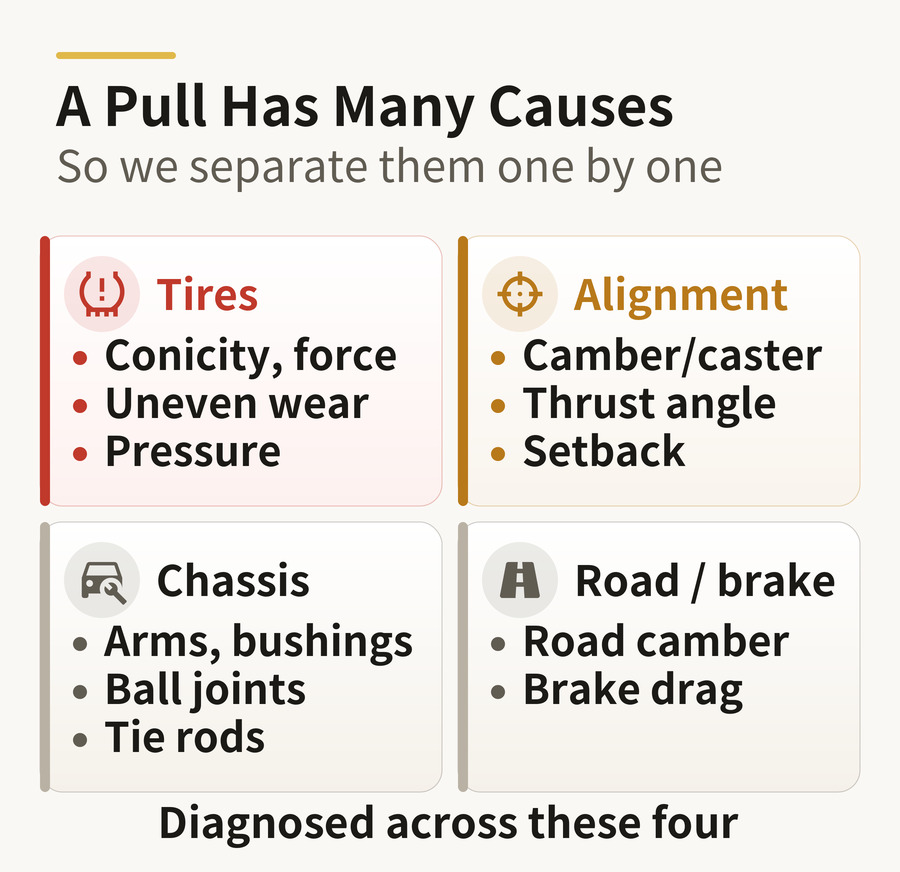
Tire forces, wheel alignment and suspension condition can contribute to the same symptom. If a pull remains after adjustment, we check for another contributing cause.
The previous alignment report and the timing of the symptom help us choose what to check next.
Numbers fine, still pulling
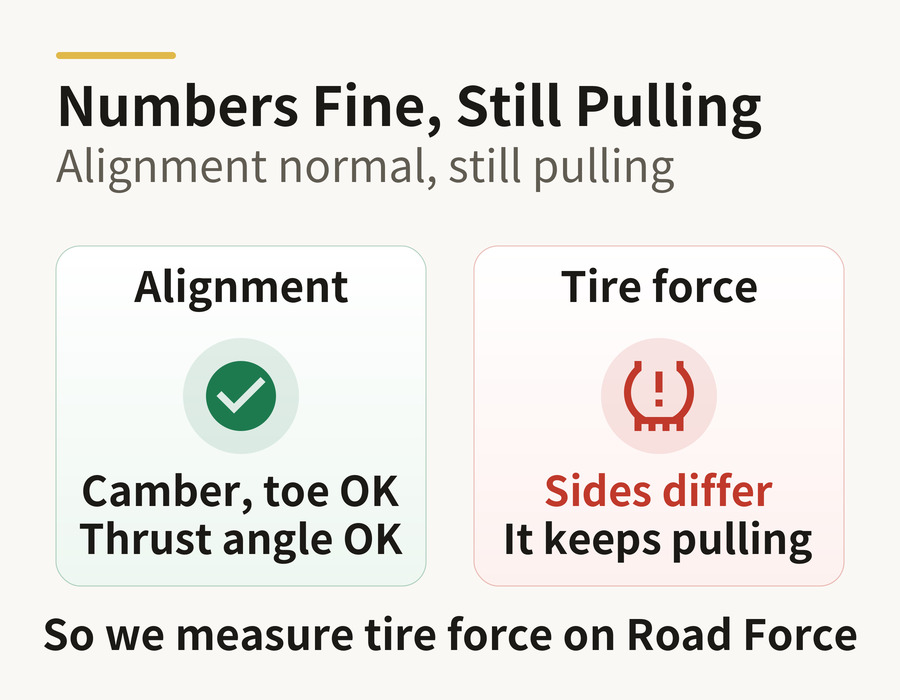
Alignment sets the angles of the four wheels. But even with every angle within spec, a tire pushes sideways with its own force. If that force differs left to right, the car keeps pulling. Re-setting the alignment will not catch it.
A new tire can carry this too. Manufacturing variation gives a tire a slight cone shape, called conicity, and that makes it pull. A spin-in-the-air balance never shows it.
Road Force measures the tire's force
That is why we use Road Force. The machine applies roller load to the tire; 567 kg (1,250 lb) is its maximum load specification. The test load depends on the tire and machine settings. For pulling, we check lateral tire force with StraightTrak and consider conicity; RFV is the separate radial-force measurement used to assess vibration. Hunter's own literature lists this measurement for diagnosing tire pull.
One note. Wheel alignment and Road Force (wheel balance) are separate jobs. We don't lump them together — we look at the car and pick only what it needs. The fees are separate too.
Road Force also produces RFV, the stiffness-variation value that shows up as vibration. Vibration and pull are different things: RFV is the vibration side, lateral force and conicity are the pull side.
Diagnosis order at NHC
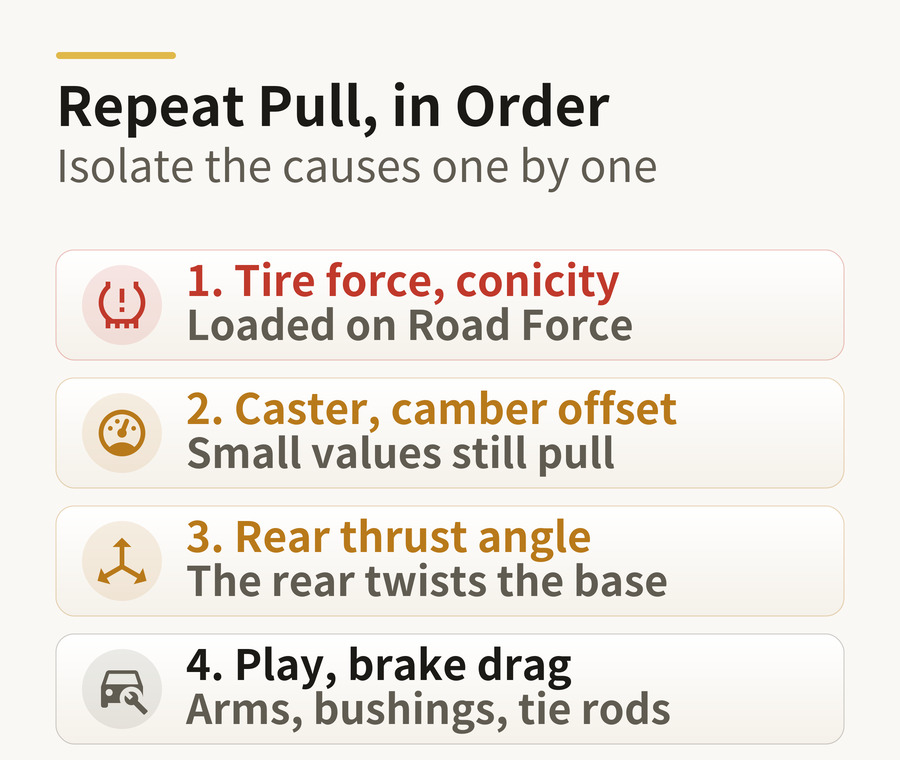
We separate it like this. First we measure tire lateral force and conicity on Road Force to tell whether the tire is the cause. If not, we look at left-right caster and camber offset — small values still make a pull. Then rear thrust angle, and finally chassis play and brake drag.
The rear is the reference
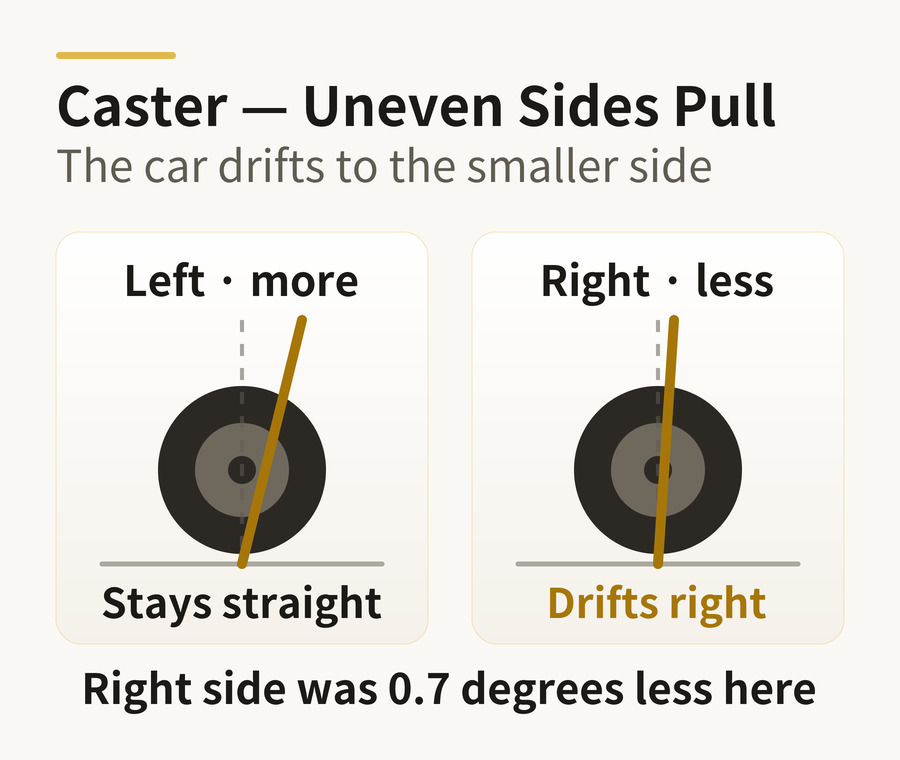
A pull that ignores the rear and looks only at the front often can't be caught. On a rear-wheel-drive car, the rear is the reference. Yet we often see cars where the rear was never touched, only the front.
Road camber matters too — the road tilts to the right for drainage, so a small error drifts the car right. We strip that out first, then read the real numbers.
A real case is on video: a new Bentley Bentayga pulled right for 16 months despite repeated alignments, until the rear thrust angle and front-tire road force were corrected together. (Korean audio; the measurement data speaks for itself.)
Measure, adjust, confirm
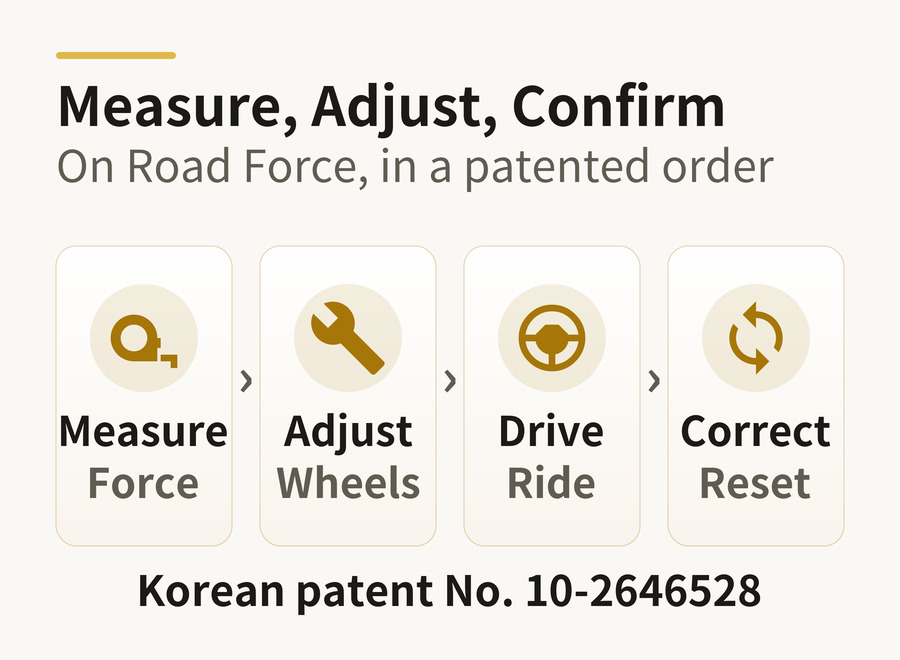
NHC Motors runs Hunter HawkEye 3D alignment and Road Force equipment. Our Road Force is the Hunter RFW (WalkAway & Revolution), the first in Korea, confirmed by Hunter Korea.
The readings need to be compared with tire condition, suspension play and the reported symptom. We check the measurement conditions, make the necessary adjustments and recheck the result.
We registered this measure-adjust-drive-correct process as a Korean patent (No. 10-2646528). A real example is in the Polestar 4 case, where the rear was the cause and the data is shown before and after.
One more note. A basic alignment takes about an hour and a half. A difficult car can run past five hours, and rarely into two days.
Repeated pulling and vibration may need different checks
We review earlier work and the conditions in which the symptom remains before deciding whether to focus on alignment or wheel-and-tyre rotation.
- Renault Grand Koleos — alignment and road testing
Front toe changed from 0.2/1.4mm left/right to 0.8/0.8mm. Rear alignment was also adjusted before the road test.
- BMW X6 — wheel repair and tyre readjustment
High-speed vibration remained after new tyres and visits to several workshops. Wheel measurement and repair, hub inspection and tyre readjustment were followed by a road test.
FAQ
I had the alignment done several times and it still pulls
Even with alignment angles within spec, if the tire itself pushes sideways with a different force, the car keeps pulling. Re-setting the alignment a few more times will not catch it. The tire force has to be measured under load to separate the cause.
How do you know the tire is the cause
Road Force loads each tire under real driving weight and measures lateral force and conicity. We also rotate the tires and watch whether the pull follows. If the pull reverses when positions change, the tire is the cause.
My tires are new and it pulls
Even a new tire can have conicity from manufacturing variation, and different left-right lateral force makes the car pull. A spin-in-the-air balance will not show it; a loaded Road Force measurement will. If the pull started right after new tires, suspect the tires first.
How is Road Force different from normal balance
Ordinary balancing measures mass imbalance without roller load. For pulling diagnosis, the equipment applies roller load and measures lateral tire force; conicity is considered separately from RFV, which concerns vibration. Hunter's own literature lists this measurement for diagnosing tire pull and calculates where to place the four tires so the total pull is minimized.
Can I get a repeat-pull diagnosis in Suwon, Korea
Yes. NHC Motors in Gwonseon-gu, Suwon runs Hunter HawkEye 3D alignment and Road Force equipment. We separate tire lateral force and conicity, four-wheel alignment, rear thrust angle, and chassis play in order, and print before-and-after data. Appointment only.
Numbers right, still pulling — we'll look
In Suwon we separate tire lateral force, four-wheel alignment, and the chassis in order, then compare before-and-after data. Test drives are agreed with the customer; if driving is not requested, we explain the findings within the measurement and inspection scope performed. NHC Motors, 524 Maesong-gosaek-ro, Gwonseon-gu, Suwon, Korea, by appointment only.
Call +82-31-258-1617 Book on NaverNHC Motors has serviced import and domestic cars in Gwonseon-gu, Suwon for nearly 30 years. Our wheel alignment and total-inspection methods are registered as two Korean patents (No. 10-2552759, No. 10-2646528), with two USPTO applications and two PCT international applications in progress. We hold Korean venture-company certification (innovation growth, first certified 2023, recertified 2026), are registered on the U.S. federal procurement system (SAM.gov), and operate Hunter HawkEye 3D alignment and Road Force equipment.