2023 BMW X6 xDrive30d · Vibration after new tyres
BMW X6: why does it shake more
after fitting new tyres?
resolved.
After all four tyres were replaced, the steering wheel and accelerator pedal began shaking from 90 km/h. The vibration grew with speed, and driving straight required constant steering corrections.
The owner had visited several workshops seeking a solution, but the vibration remained. They then brought the car to NHC. We repaired the bent wheels, rematched the tyres and completed alignment adjustments and a test drive.
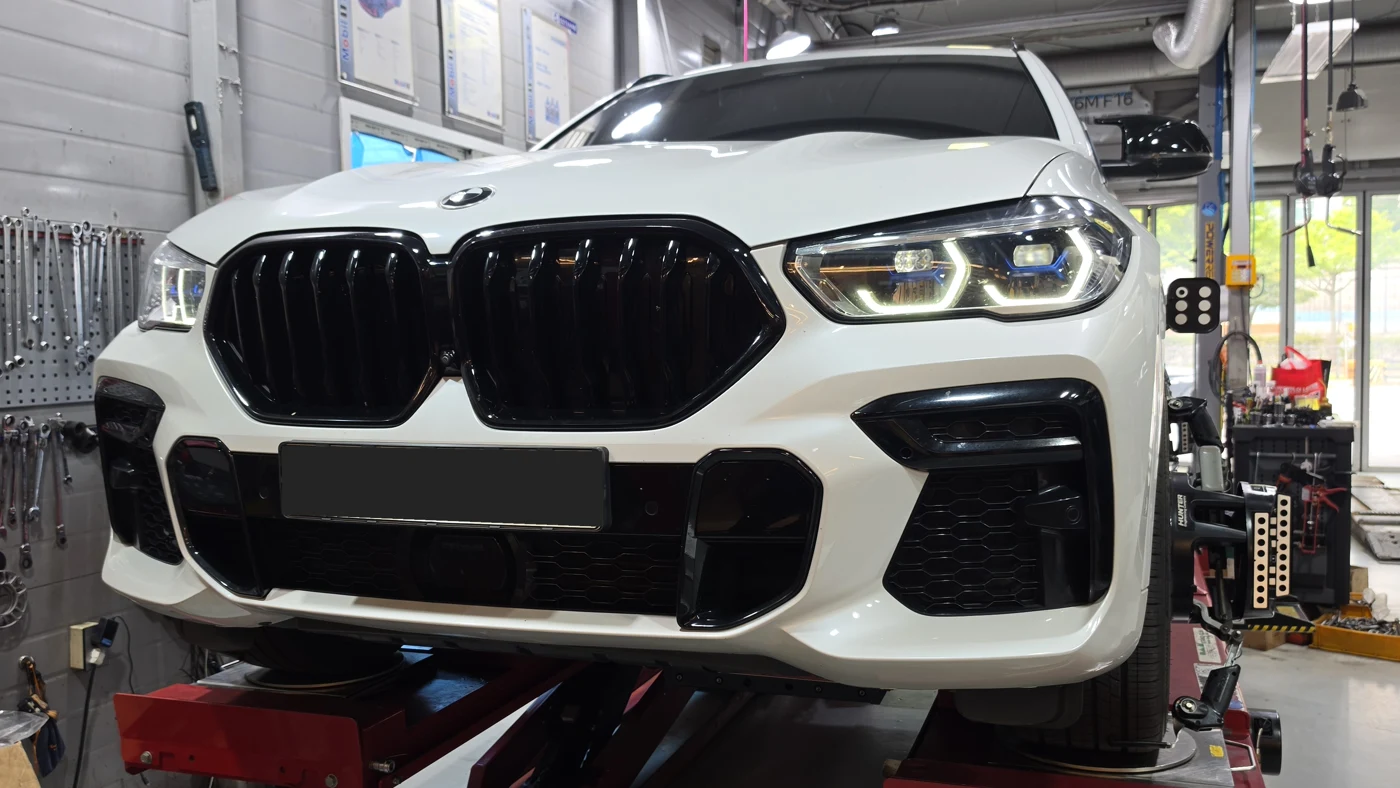
- Vehicle
- 2023 BMW X6 xDrive30d (G06) · 114,365 km · 22-inch wheels, 275/35R22 front / 315/30R22 rear
- Reason for visit
- Steering and accelerator pedal vibration above 90 km/h after a tire change, plus constant steering correction when driving straight
- Work performed
- Wheel straightening · Road force matching · Hub cleaning · Spacer replacement · Alignment · Test drive
- Result & remaining item
- Original vibration not reproduced · One 12.0 kgf RFV reading and caster difference remain and were discussed
01
The vibration began after new tyres were fitted
This 2023 BMW X6 xDrive30d had covered 114,365 km. The vibration began immediately after four Hankook Ventus S1 evo Z AS X tyres were fitted: 275/35R22 front and 315/30R22 rear.
The shake began at 90 km/h, increased at 100 km/h and was strongest at 120 km/h. It could be felt through both the steering wheel and accelerator. The car also required frequent steering corrections when travelling straight.
The vibration remained after visits to several workshops
The owner had sought help at several workshops. At NHC, we first reviewed the service history and the symptoms still present.
The report records replacement of both tension struts, plus transmission, transfer-case and differential oil changes. The car had 10 mm front and 15 mm rear spacers installed.
We checked the parts already replaced and the current installation before investigating the vibration. Wheel runout and tyre force variation measurements guided the repair and adjustment work.
02
How true does the wheel run – runout measurement
We used a HOFMANN 9000P_EU wheel balancer to measure wheel runout, checking the inner and outer rim in both radial and lateral directions. The measuring equipment records the wobble appearing over one rotation, split between the inner and outer rim and between the vertical direction (radial) and the side-to-side direction (lateral). The P-P figures in the table are the total swing of the reading through one rotation; the wider that swing, the more likely it shows up as vibration on the road.
One wheel in the record showed an inner radial P-P of 0.75 mm, above the 0.70 mm management limit shown by that equipment. That 0.70 mm is the management figure of the measuring equipment used, not a common tolerance set by BMW. After correction the same item came down to around 0.1 mm, and the lateral swing narrowed as well.
| Equipment used | What we checked |
|---|---|
| HOFMANN 9000P_EU Wheel balancer | Inner and outer rim runout in radial and lateral directions, compared before and after repair. |
| Hunter Road Force WalkAway Road force balancer | RFV of the wheel-and-tyre assembly under roller load, with remeasurement after changing the mounting position. |
Wheel runout before and after repair
Grey: before · Gold: after · Unit: mm
| P-P (mm) | Before | After |
|---|---|---|
| Radial · inner | 0.75 | 0.10 |
| Radial · outer | 0.35 | 0.20 |
| Lateral · inner | 0.45 | 0.10 |
| Lateral · outer | 0.20 | 0.05 |
One wheel recorded in the HOFMANN 9000P_EU measurement report. P-P is the peak-to-peak variation. The report lists a 0.70 mm management limit; this is not presented as a universal BMW specification.
View the recorded Act. readings
| Act. (mm) | Before | After |
|---|---|---|
| Radial · inner | 0.1 | -0.05 |
| Radial · outer | 0.15 | -0.1 |
| Lateral · inner | -0.11 | -0.04 |
| Lateral · outer | 0.06 | -0.03 |
A negative Act. reading is not inherently better. Use the P-P values above to compare the recorded variation.
Right rear · Before / after wheel repair
Right front · Before / after wheel repair
03
Measuring again under load – road force and matching
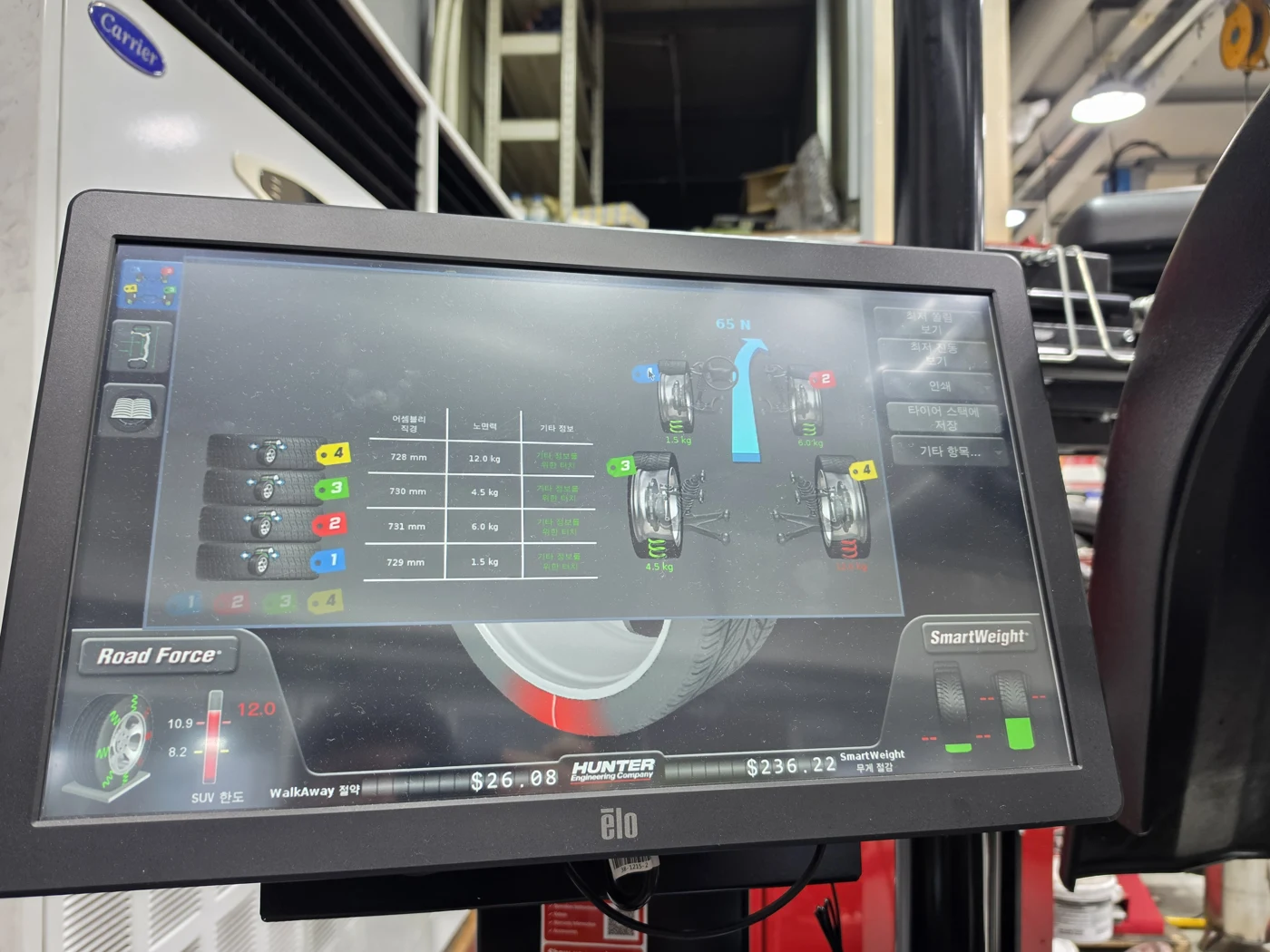
Balance weights correct mass imbalance. Road force measurement applies a roller load to assess how force varies as the assembly rotates. On the Hunter Road Force WalkAway used here, we checked rim condition, matching guidance and the measured result. A prediction was followed by actual reassembly and remeasurement.
At handover, the technician described an initial reading of approximately 22 kgf among the assemblies. One assembly needed repeated matching: it reached 12.0 kgf, but another attempt raised it to around 19 kgf. We retained the lowest achieved setting and reviewed placement on the vehicle.
The final readings were 1.5, 6.0, 4.5 and 12.0 kgf. The 12.0 kgf assembly was placed at the right rear and remained flagged high on the equipment. This was explained to the owner, including the option of raising a tyre quality enquiry. Our road force guide (Korean) explains the measurement.
ROAD FORCE · FINAL
Final placement and road force readings
Unit kgf · Displayed as kg
Final RFV readings · Unit kgf (displayed as kg)
| Assembly | Measured diameter | RFV |
|---|---|---|
| 1 | 729 mm | 1.5 kgf |
| 2 | 731 mm | 6.0 kgf |
| 3 | 730 mm | 4.5 kgf |
| 4 | 728 mm | 12.0 kgf |
Diameter is the machine reading for the wheel-and-tyre assembly, not ride height or wheel runout.
04
Cleaning the mating surface and changing the spacers
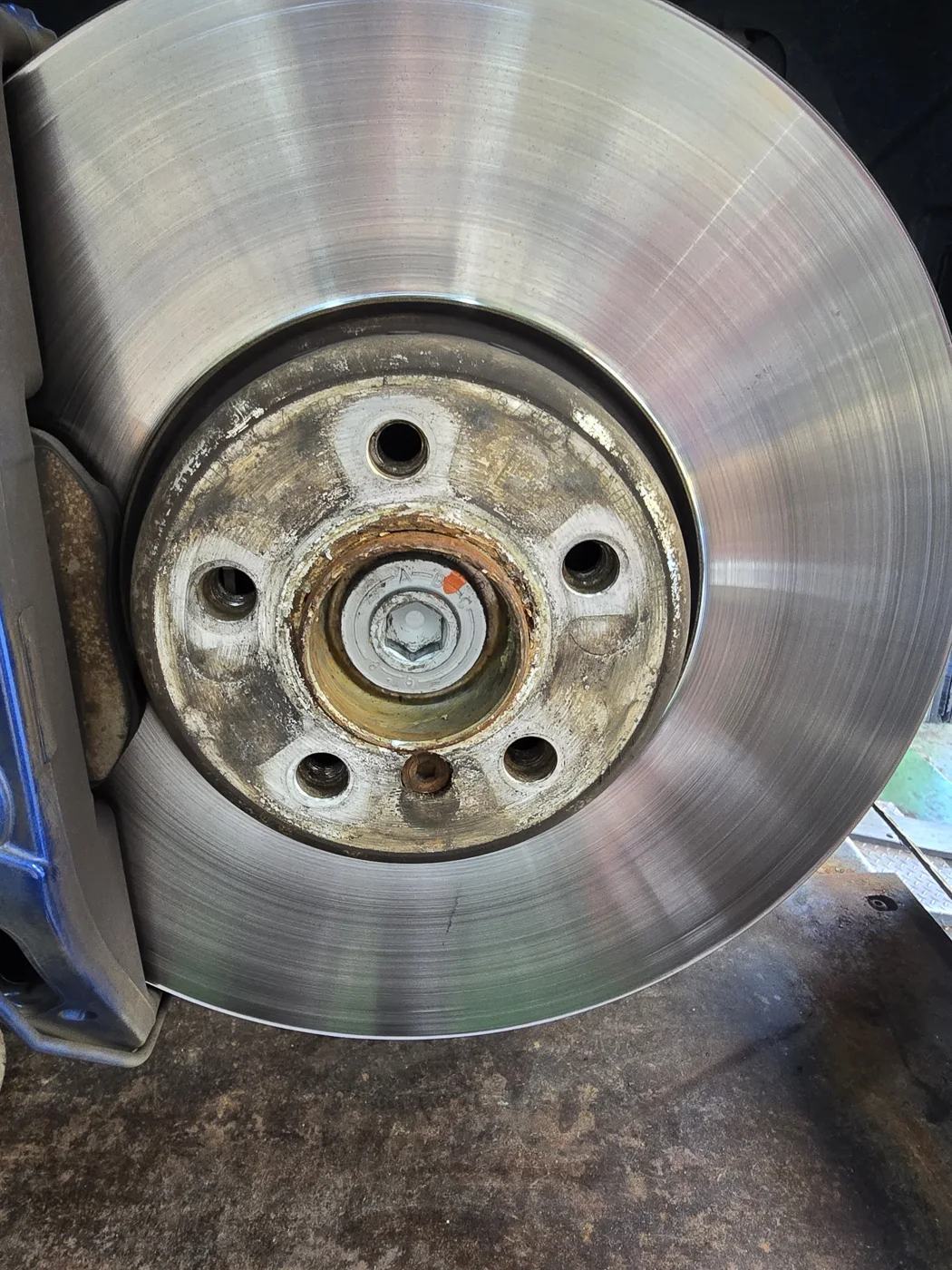
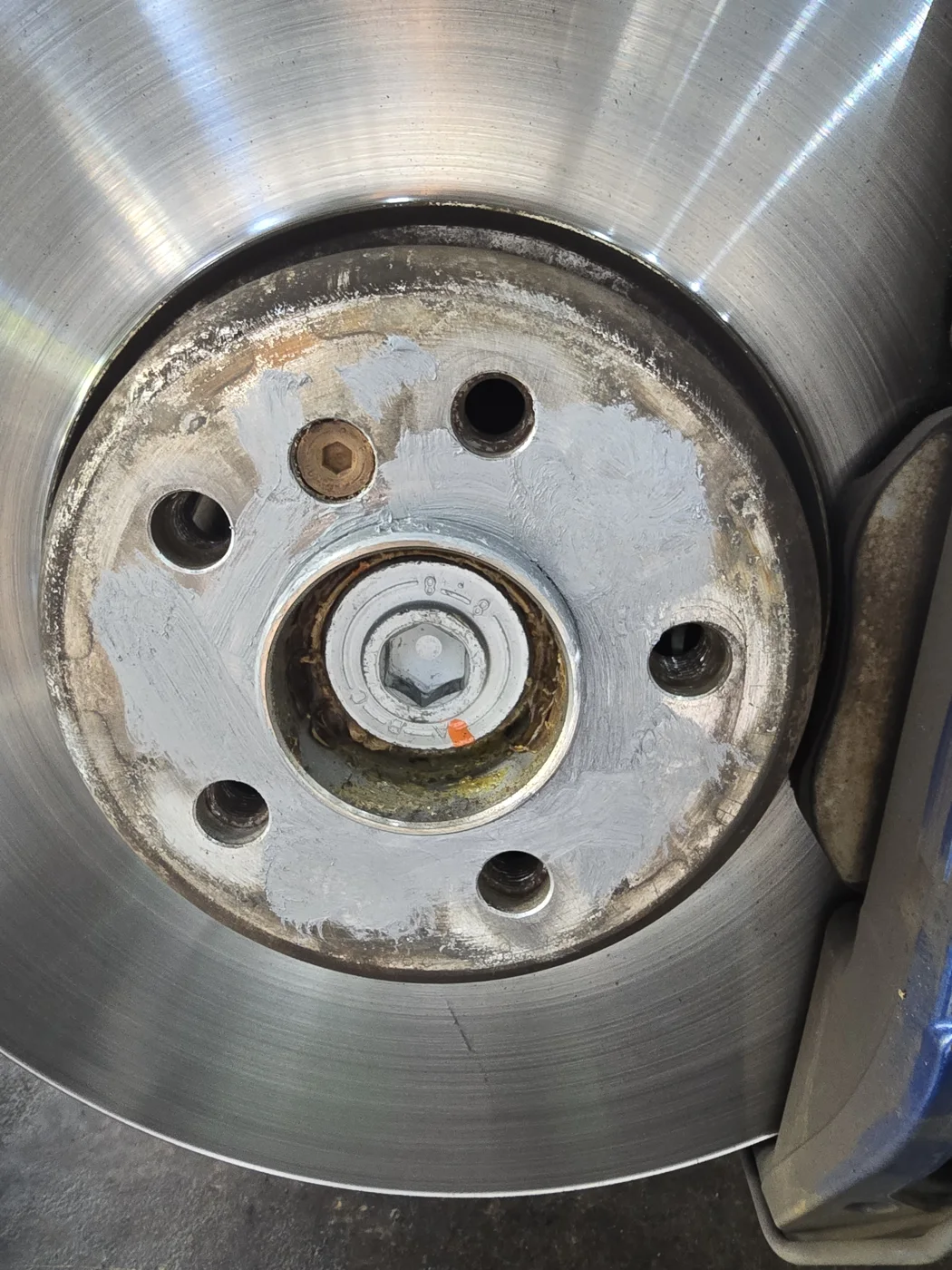
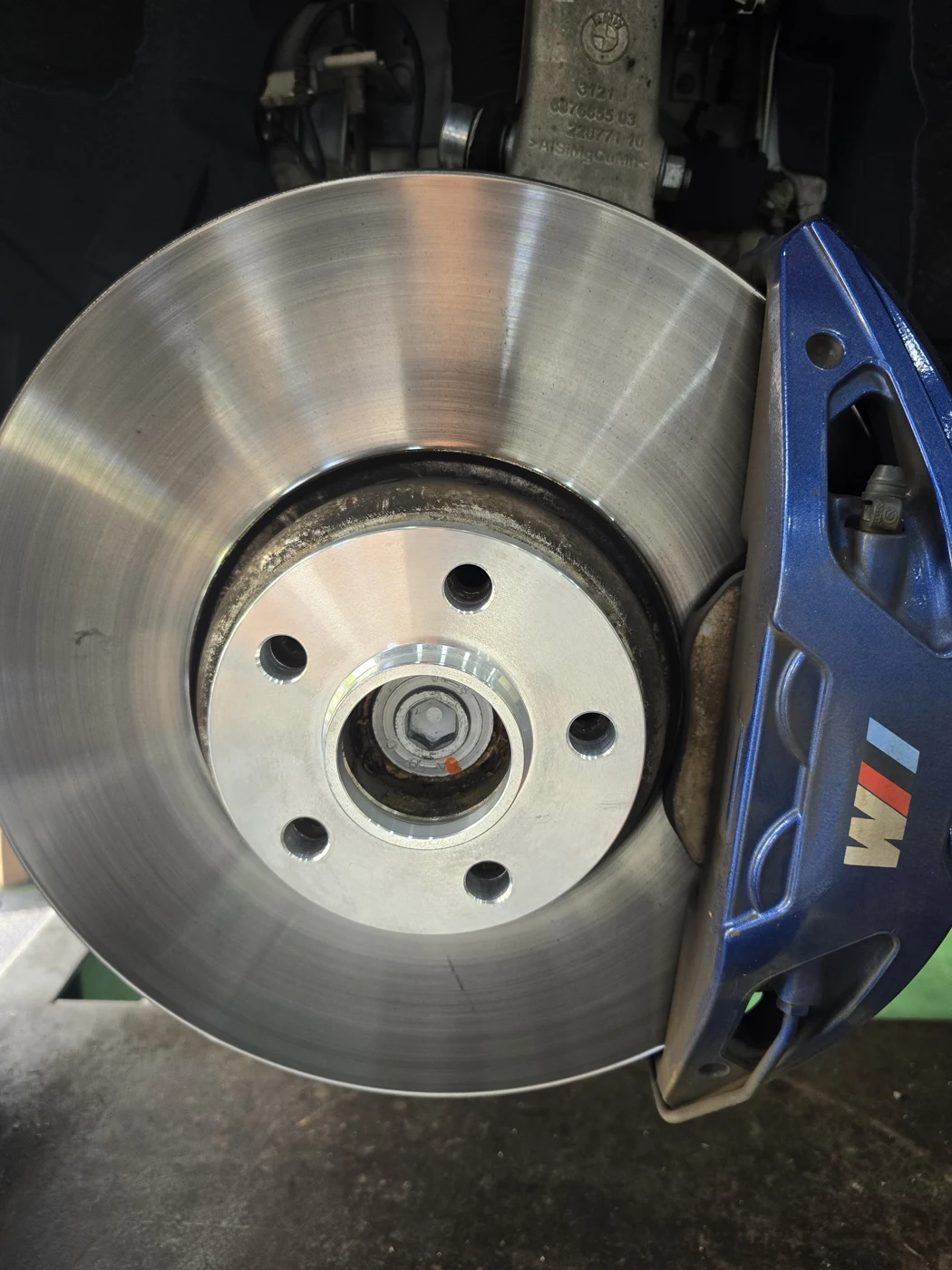
The surface where the wheel meets the hub is a surface that needs attention during assembly. If corrosion or debris remains on that face, the wheel gets torqued down very slightly tilted, and that misalignment is hard to feel at low speed but shows up as shake at high speed.
On this car debris was present on the hub mating surface, so we cleaned the face and applied a thin coat of anti-seize to the mating surface only, to prevent seizing. It is not applied to brake friction surfaces. We then fitted the spacers to the specification proposed by the technician and approved by the owner: one-piece aluminium units, front 10 mm → 15 mm and rear 15 mm → 20 mm.
The spacers were not identified as the direct vibration source. They were replaced to improve the hub-centering arrangement and change the track setting, and it is not something we recommend for every vehicle. What does follow from it is that when the specification changes, the mating surfaces have to be cleaned, the fastening checked, and the alignment re-checked.
05
Adjusting alignment and recording the remaining differences
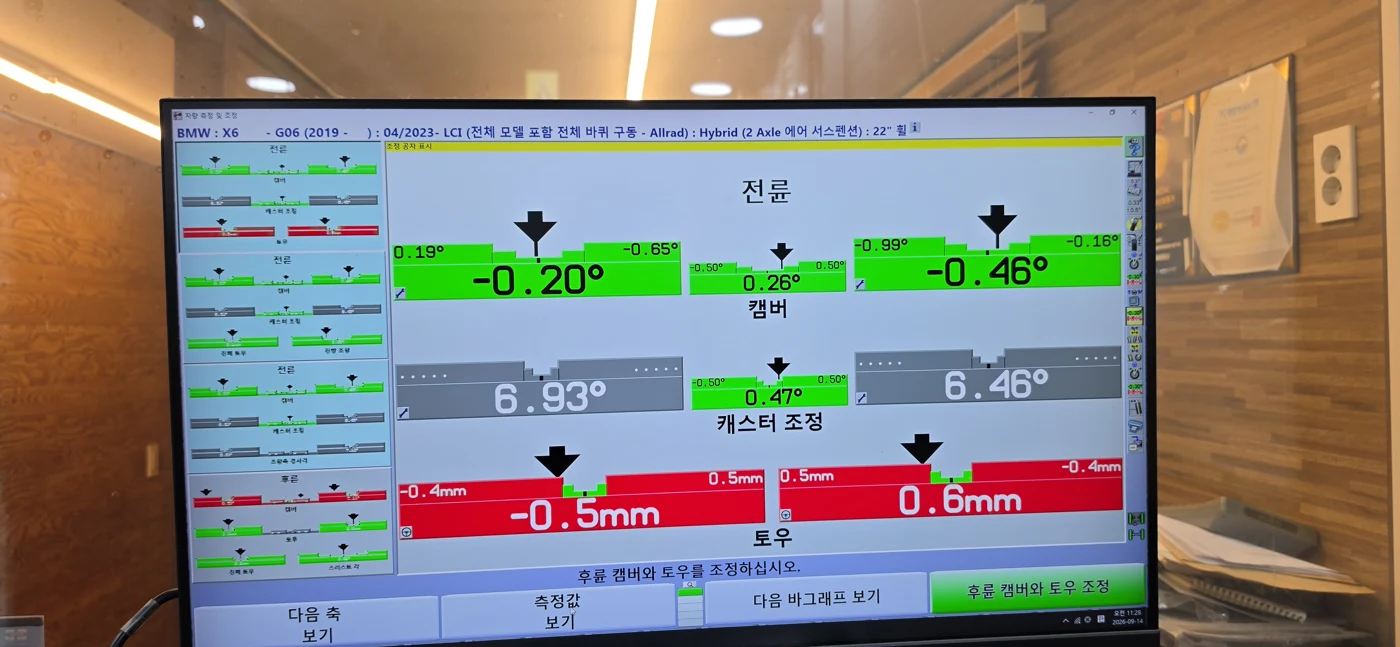
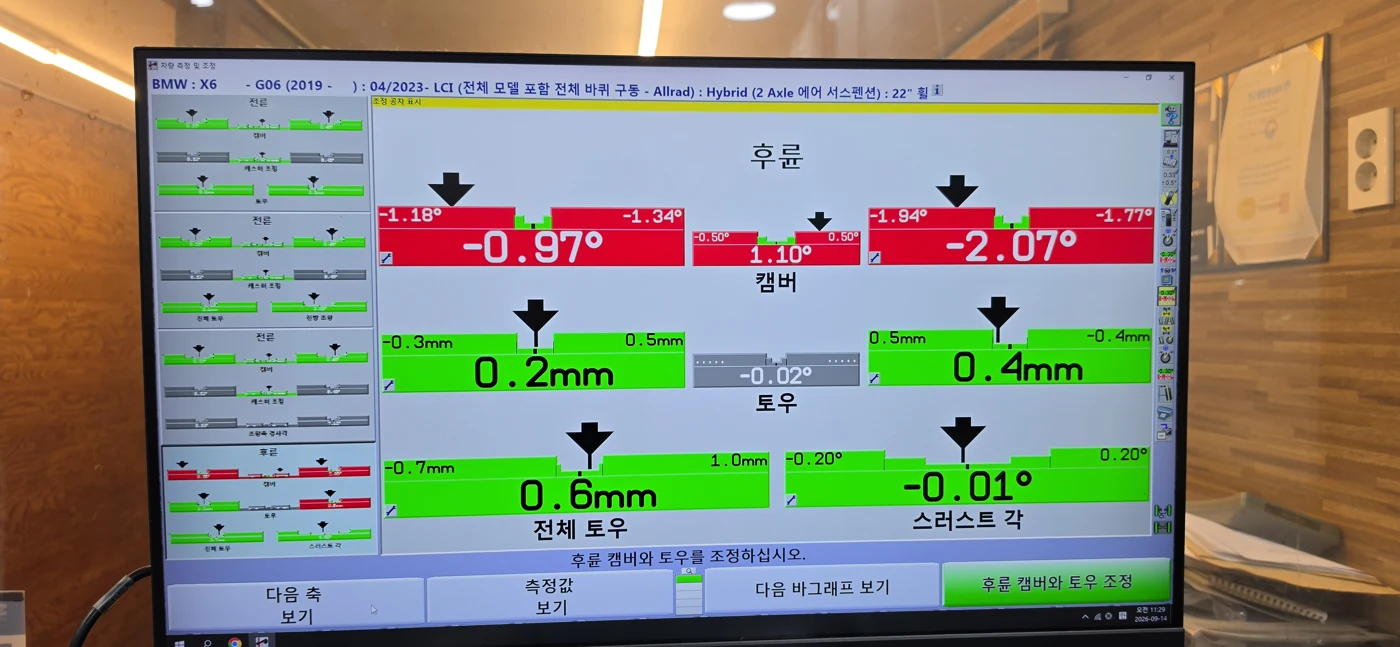
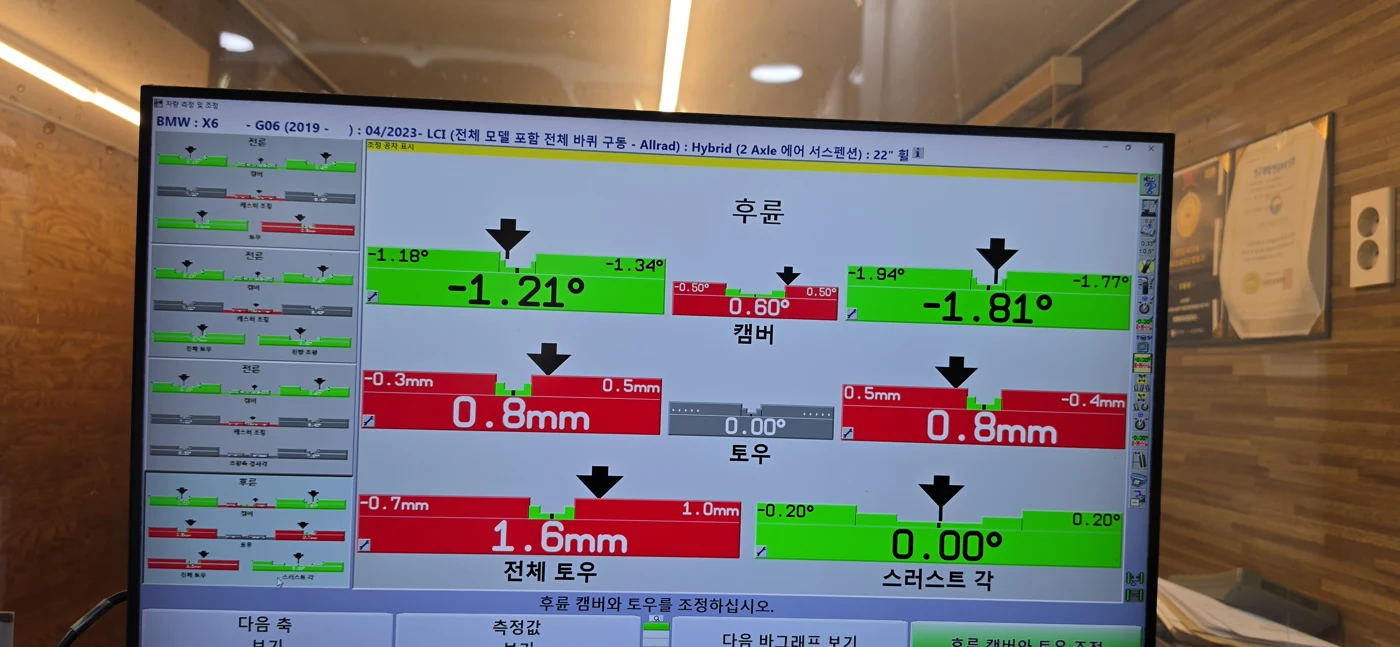
Left-front toe was −0.5 mm, toe-out, while right-front toe was 0.6 mm, toe-in. Rear camber differed by 1.10° side to side. We addressed these differences alongside the wheel and tyre condition.
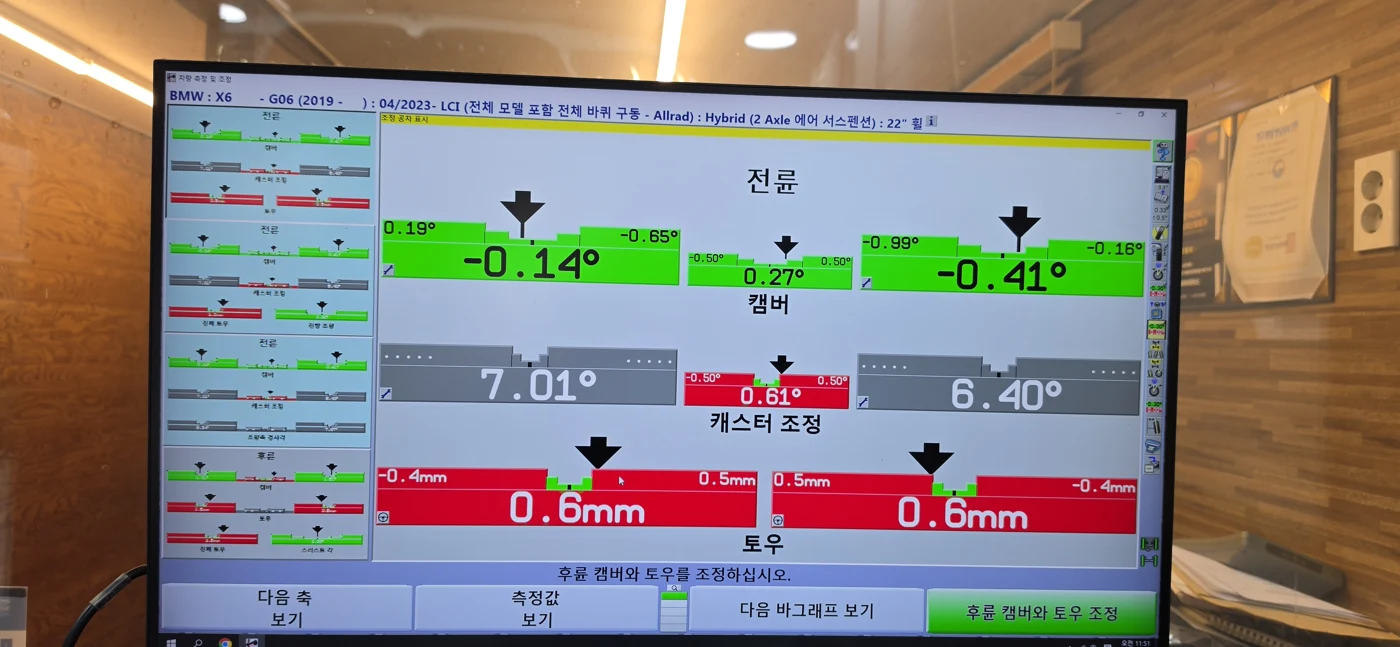
The in-process records show front toe at 0.6/0.6 mm and rear toe at 0.8/0.8 mm. Rear camber difference was 0.60° and thrust angle was recorded as 0.00°. Thrust angle describes the rear wheels’ direction of travel relative to the vehicle centreline.
A caster difference remained. On further suspension work, the technician explained, “If the symptom is resolved, there is no need to do it.” Based on the test drive, suspension parts were not replaced solely to equalise caster.
The setup took the spacer installation into account. We do not claim every reading falls within the factory limits. These photographs record work on 14 September; these are dated adjustment records, not a claim about final delivery settings.
TOE DIRECTION · BEFORE / AFTER
Equalising left and right toe
Before adjustment
Actual toe readings · mm
After adjustment
Actual toe readings · mm
| Measurement | Before | After |
|---|---|---|
| Front toe L/R | −0.5 / 0.6 mm | 0.6 / 0.6 mm |
| Rear toe L/R | 0.2 / 0.4 mm | 0.8 / 0.8 mm |
| Front camber L/R | −0.20° / −0.46° | −0.14° / −0.41° |
| Rear camber L/R | −0.97° / −2.07° | −1.21° / −1.81° |
| Caster L/R | 6.93° / 6.46° | 7.01° / 6.40° |
| Thrust angle | −0.01° | 0.00° |
06
Test drive findings and ongoing care
After the work, our technician took the car out personally. In both Comfort and Sport modes the high-speed vibration reported at check-in did not reappear, and his assessment was that straight-line stability and the car's response during lane changes were more settled than before.
The assembly with a remaining 12.0 kgf road force reading warrants continued attention. Even if it is not noticeable now, it sits above the management range, so while the same tires stay on the car, any faint shake returning at speed means that assembly's tire should be checked first. If the deviation is in the tire itself, replacing that tire is the next step to consider.
Frequently asked questions
I just fitted new tires — why is there vibration at high speed?
Vibration can remain even when balance is correct. The wobble a rim traces as it turns, the force variation a tire produces under load, and the condition of the surface where the wheel meets the hub are three separate causes. That is why we work through runout measurement, road force measurement, hub mating surface inspection and alignment in order.
What happens if a road force value is still high?
If the reading remains high after matching, wheel and tyre condition need reassessment, including whether a tyre quality enquiry or replacement is appropriate. Here we explained the remaining 12.0 kgf reading, reviewed placement and checked the car on a test drive.
Do spacers mean the alignment has to be redone?
When installation conditions change, the mating surfaces, fastening and alignment should be checked together. The spacer installation was considered in this setup.
Before replacing the tyres again, let us find out why the car shakes
If new tyres or another balance check have not resolved the vibration, contact us. We will inspect the fitted wheels and tyres and explain what repair and adjustment may improve.
We explain the required scope and estimate before beginning the work with your agreement.
Call for service adviceBook on Naver524 Maesonggosaek-ro, Gwonseon-gu, Suwon · By appointment. Scope and estimate explained first.
Related cases and guidance
Road force balancing guide (Korean) · Wheel alignment guide (Korean)
DB11 wheel repair and vibration case — Another example of wheel repair followed by checks after assembly.