Persistent right pull
Polestar 4 Pulling Right — Three New Cars Inspected
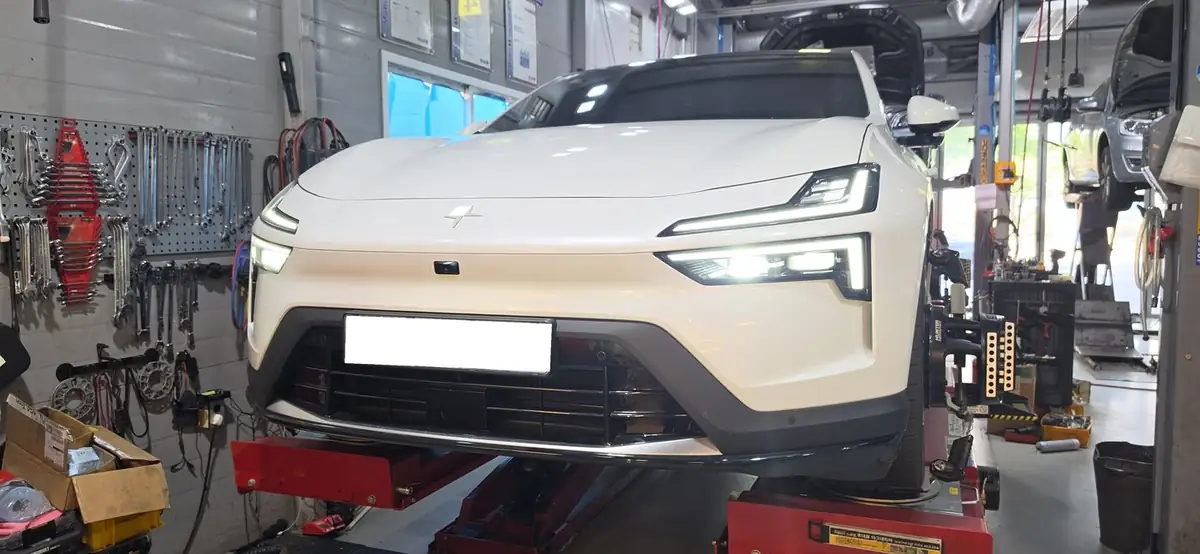
The Polestar 4 has been delivered in Korea since November 2024. A lot of owners came to us saying it pulls to the right. In a short window we saw three of them.
Contents
- Symptom — lane drift hands-off
- Right pull, three types
- Right pull is common
- A familiar reading — caster offset
- The whole process on video
- Diagnosis order
- What was different — the rear
- Before and after
- The front alone can't fix it
- A car with no adjustment bolts
- The tires too — 25N to 5N
- Tires can't be undone
- Owner's review
- Key takeaways
- FAQ
All three pulled right. Some arrived with an alignment already called normal. But once we dug in, the cause was a little different each time. This is what we measured and judged on the third car.
Symptom — lane drift hands-off
Most owners had already had it adjusted a few times. It is a new car, so the warranty is still valid, and they were likely serviced under warranty first. When that did not solve it, they came to us.
The first thing we do is a test drive. Two street lights are roughly 100m apart. Hands off over that span, within 1m left or right is normal. We repeat it, not once — ten out of ten pulls is a confirmation. This car was past that line.
Right pull, three types
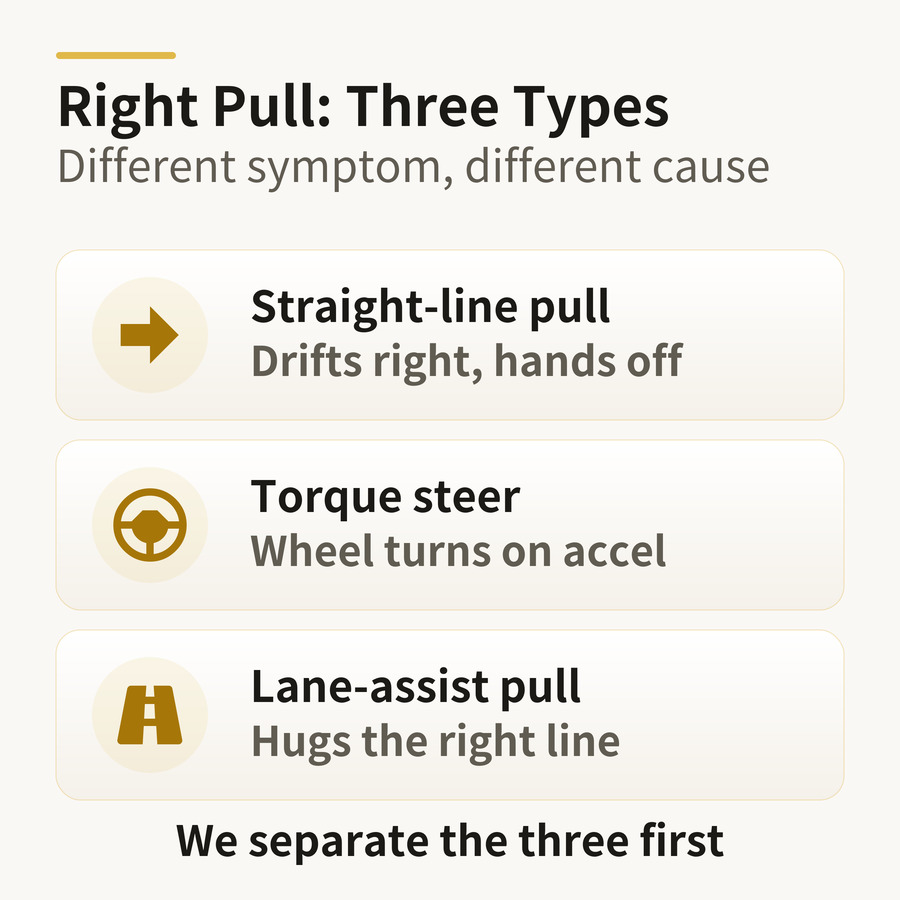
First we separate the symptom. Owners describe right pull in three ways: drifting right when going straight, the wheel turning right on acceleration or braking, and driver assist hugging the right lane line.
They look alike but point to different places. This car had both straight-line pull and wheel turn together, so alignment alone was never going to answer it.
Right pull is common
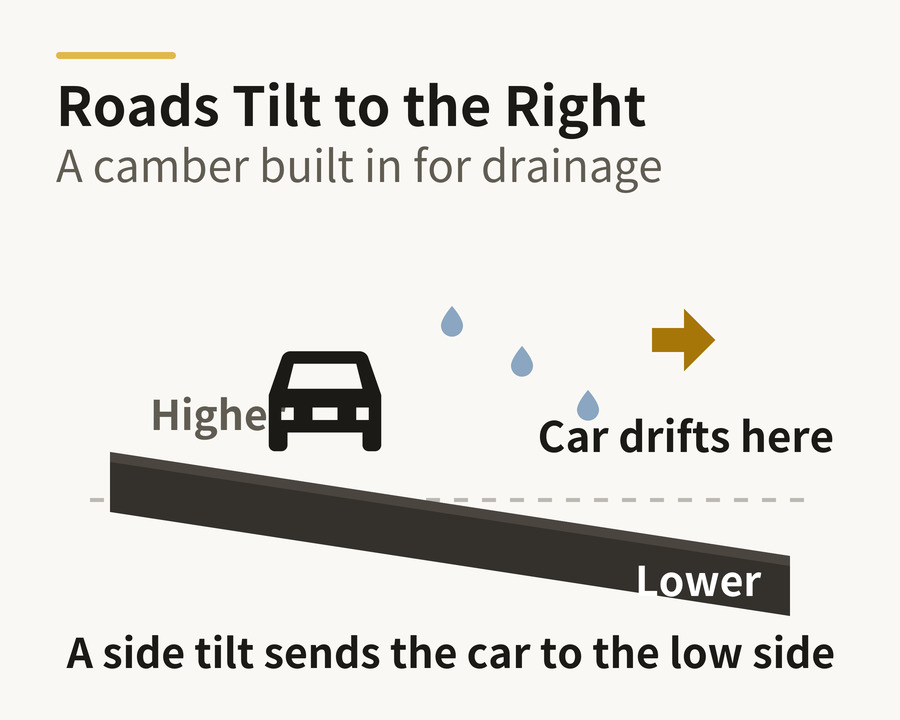
Pulling right is a typical symptom. Roads are built with a slight tilt to the right so water drains off. That is called camber. So even a small alignment error lets the car drift right.
Most right pulls are solved by allowing for that camber and setting the alignment. That is the basic method. But this owner had it adjusted several times under warranty and still came to us. That means the basic method did not catch it, so we look at what comes next.
A familiar reading — caster offset
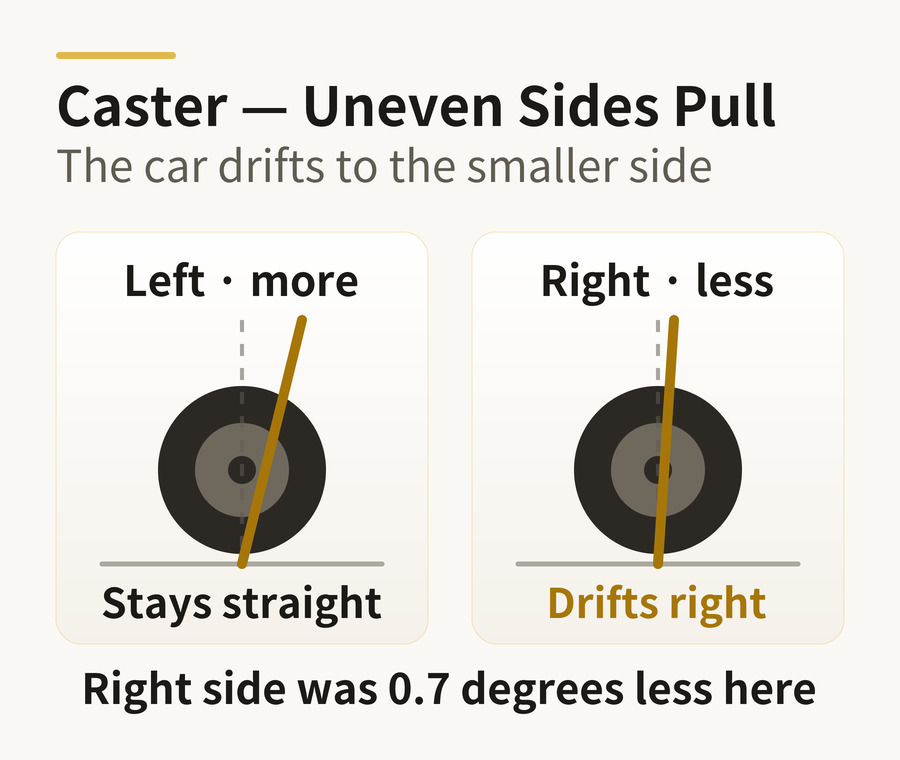
The reading looked familiar. Caster is the tilt of the steering axis. When the two sides differ, the car flows toward the side with less caster.
One car was 0.7 degrees less on the right. A Polestar 4 we had seen months earlier was 0.8 to 0.9 degrees less on the right. Ordinary cars pull hard at just 0.5 degrees, and you feel it at 0.3. With less caster, the passenger-side wheelbase came out 10mm shorter too.
Two cars in a row, same direction, similar size. That is not common. Still, we don't conclude from two or three. If the next car and the one after look the same, it becomes a question of the suspension assembly stage, not the individual car. We will write it up again once more data stacks up.
The whole process on video
Intake, test drive, measurement, adjustment, and the re-drive — the whole process is in the video.
Diagnosis order
A pull rarely has a single cause. So we erase them one by one, in order.
- Reproduce the symptom on a test drive. Which way, and how much.
- Separate the road camber. Roads tilt for drainage, so we strip out the pull that tilt creates first.
- Check for torque steer under hard acceleration.
- Measure the four-wheel angles with Hunter HawkEye 3D.
- Measure the force the tires push with, using Road Force.
- Adjust, then re-drive. A technician rides along to confirm.
What was different — the rear
On one car the front toe was within spec. Saying the alignment was normal was not wrong — if you only look at the front.
The problem was the rear. Rear left toe was -0.4mm, out of spec, the thrust angle was -0.04°, and the axle offset was -2mm. On a rear-based car the rear is the reference. When the rear is off, the whole car leans that way.
Before and after
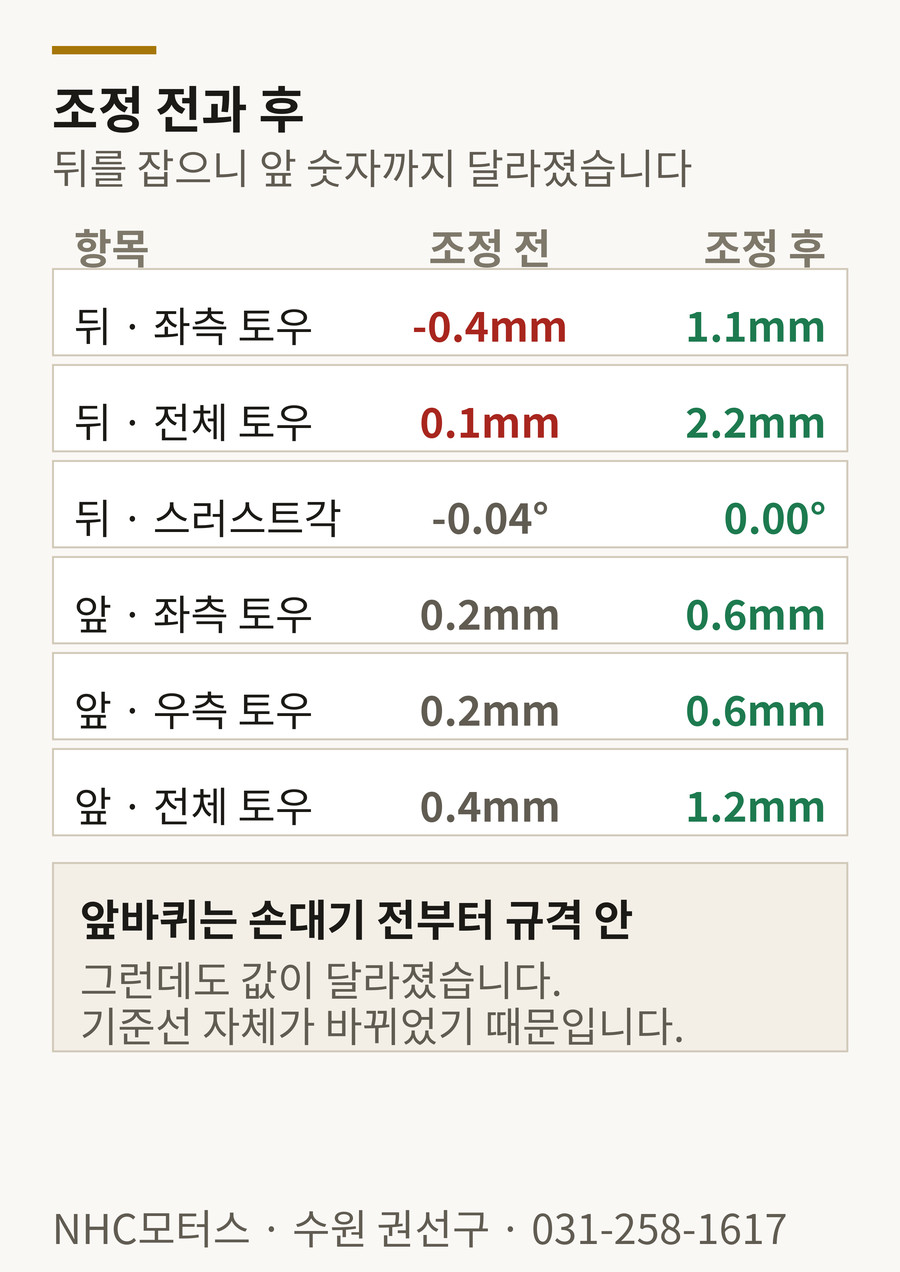
| Item | Before | After |
|---|---|---|
| Rear thrust angle | -0.04° | 0.00° |
| Rear left toe | -0.4mm | 1.1mm |
| Rear total toe | 0.1 | 2.2 |
| Axle offset | -2mm | 0mm |
| Front total toe | 0.4 | 1.2 |
We brought the rear thrust angle from -0.04° to 0.00°. Rear left toe went back within spec, and axle offset moved from -2mm to 0.
The front alone can't fix it
Here is the key. The front was within spec before we touched it. But once we set the rear to 0.00°, the reference line shifted, and the front numbers changed too. Front total toe was re-set from 0.4 to 1.2.
So if you only look at the front and call it normal, this car keeps pulling. You have to re-check front and rear against the rear as the base.
A car with no adjustment bolts
There was a harder case. A Polestar 4 barely a month old, only 400km. This car ships with no caster or camber adjustment. Only front toe can be set. There are no special parts like on a BMW. You can know the cause and still not bolt it out.
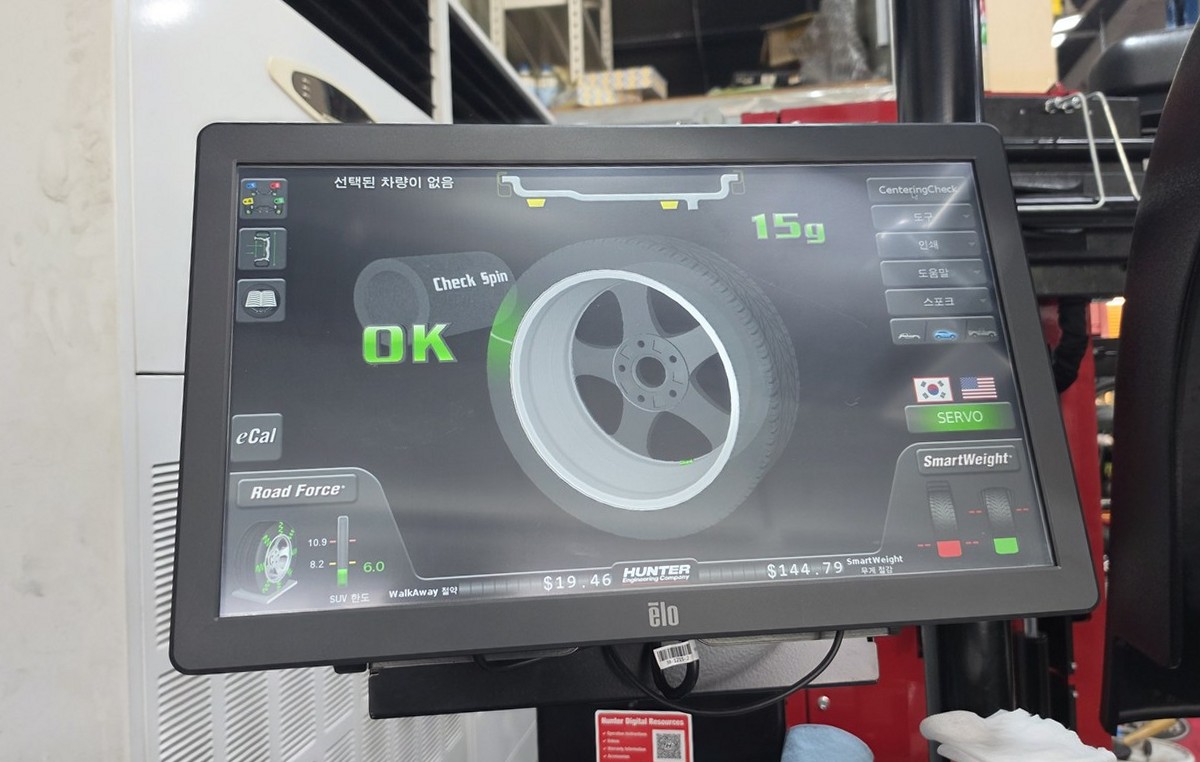
So we went at it with Road Force. On our Hunter Road Force (RFW WalkAway & Revolution, first in Korea, confirmed by Hunter Korea) the front tire read 13. We treat 7 as the passenger-car limit and 9.1 as the equipment's defect threshold, so it was a maxed-out reading. The rear was 4.5, healthy. Caster set the direction, and the front tire's kickback pushed it.
With no adjustment bolts, we handled the rest through the tires. We set the toe that can be set, re-assembled the wheel and tire so their offsets cancel (matching), and placed a tire whose conicity pulls left to offset the right pull. It is how you build the best result within a car that has no adjusters.
The tires too — 25N to 5N
It is not only alignment. Tires push sideways with different force too. We measured all four with Road Force and optimized their positions.
Road Force loads the tire with real driving weight (up to 567 kg (1,250 lb)) as it spins. Two values come out. One is RFV, the stiffness-variation value that shows up as vibration. The other is lateral force and conicity, the sideways value that shows up as pull. Vibration and pull are different things.
On one car this optimization dropped the expected pull from 25N to 5N. With the angles set and the tires matched, the car tracked straight again.
Tires can't be undone
One thing to note. Even at only 400km, a sport tire has already worn. It wore in the direction of the pull, so returning it to 100% of new was not possible.
Alignment can be undone, but wear cannot. A new-car pull saves the tire the sooner you catch it. If you have been stopped by "a new car couldn't do that," check it with measured data.
Owner's review

"I'm the owner in the video. The service center couldn't fix it no matter what, but after this visit it improved a great deal and I'm very satisfied. There is still an underlying issue with the car to work through, but they made it a car I can actually drive again. My thanks to the shop." (translated from Korean)
We share the review as it is. The improvement is big, but the owner says an underlying part remains. We don't claim we caught everything either. What's left, we treat as what's left.
Key takeaways
These numbers are each individual car's measurements. Even the same Polestar 4 varies unit to unit. So we don't diagnose a cause remotely. You have to see and measure the car.
But the principle holds. A pull does not end at the front wheels. The rear, caster offset, tire force, and road camber overlap. If your alignment was called normal and it still pulls, the rest may not have been checked.
The principle and diagnosis order are in the guides section, and the Korean version of this case is here.
FAQ
Do all Polestar 4s pull like this
We do not generalize. We saw a repeated caster offset on the right across a few cars, but two or three cars are not a conclusion. These numbers belong to each individual car. The same model varies unit to unit, so we judge only after inspecting the car in person.
The alignment was normal, so why did it pull
On one car the front toe was within spec, but the rear was out. Rear left toe was -0.4mm and thrust angle was -0.04°. On a rear-based car the rear is the reference, so looking at the front alone cannot fix it. Another car was a mix of caster offset and front tire Road Force.
Polestar 4 has no caster adjustment, so how do you fix it
The Polestar 4 ships with no caster or camber adjustment, so only front toe can be set. Sometimes you know the cause but cannot bolt it out. In that case we measure the tire forces with Road Force, set the toe that can be set, and use wheel-tire matching and conicity offset. It is the best result achievable within the car's fixed condition.
What does a high Road Force number mean
Road Force loads the tire under real driving weight and measures the force variation per revolution (RFV). One Polestar 4 read 13 on the front tire. We treat 7 as the passenger-car limit and 9.1 as the equipment's defect threshold, so it was a maxed-out reading. The rear was 4.5, which is healthy. The front tire's kickback was pushing the pull.
Can you check my car this way
Yes. NHC Motors in Gwonseon-gu, Suwon runs Hunter HawkEye 3D alignment and Road Force equipment, separating tire lateral force, four-wheel alignment, and rear thrust angle in order. We print before-and-after data and confirm with a ride-along test drive. Appointment only.
Normal numbers, still pulling — we'll look
In Suwon we separate tire lateral force, four-wheel alignment, and the rear in order, then confirm with before-and-after data and a ride-along test drive. NHC Motors is at 524 Maesong-gosaek-ro, Gwonseon-gu, Suwon, Korea, by appointment only.
Call +82-31-258-1617 Book on NaverNHC Motors has serviced import and domestic cars in Gwonseon-gu, Suwon for nearly 30 years. Our wheel alignment and total-inspection methods are registered as two Korean patents (No. 10-2552759, No. 10-2646528), with two USPTO applications and two PCT international applications in progress. We hold Korean venture-company certification (innovation growth, first certified 2023, recertified 2026), are registered on the U.S. federal procurement system (SAM.gov), and operate Hunter HawkEye 3D alignment and Road Force equipment.