한국어 · NHC MOTORS / MERCEDES-BENZ E300
TYRE · WHEEL · ROAD TEST
Mercedes-Benz E300: vibration after repeated balancing — tyre replacement and wheel straightening
Vibration remained at 90–100 km/h after repeated balancing. We measured the wheel and tyre assemblies, repaired the rims and replaced the front tyres, then checked the car on the road again.
01 / E300
Repeated balancing had not removed the vibration
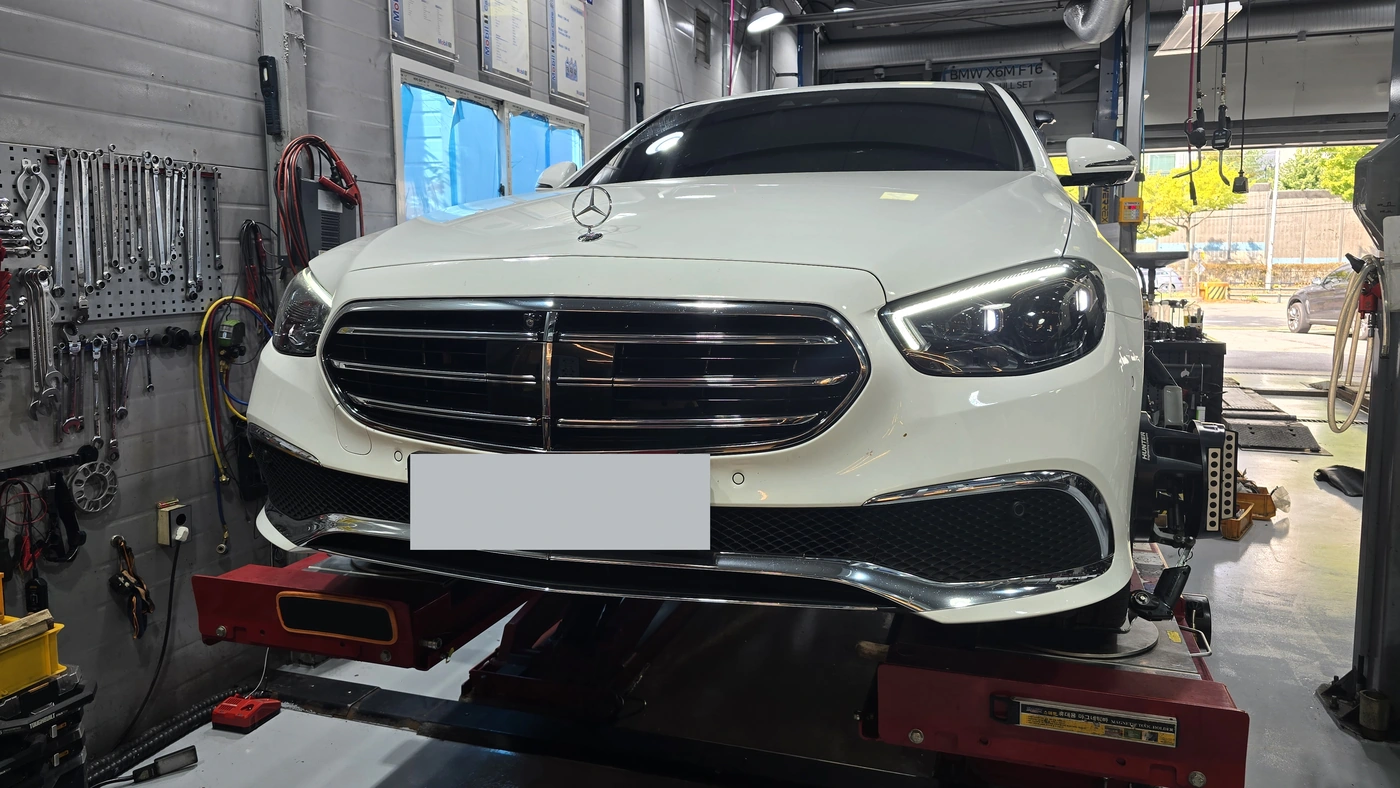
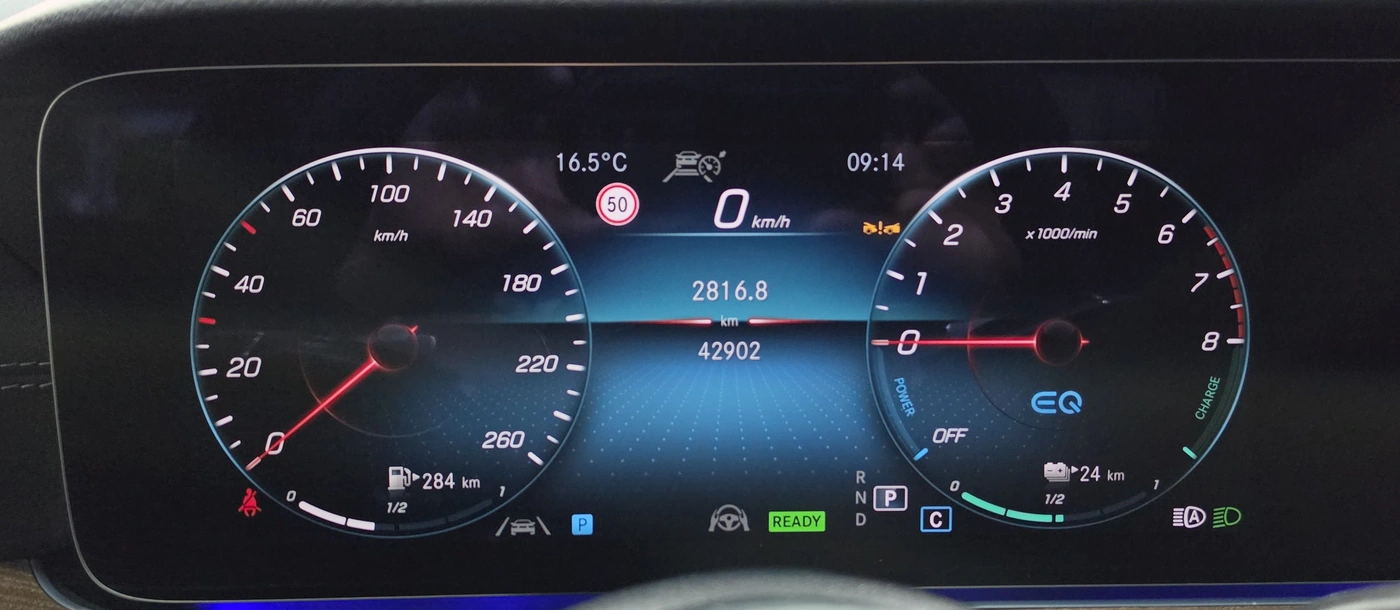
This E300 came in with vibration through the steering wheel and seat at 90–100 km/h. One tyre had been replaced, the wheels had been refurbished elsewhere, and the balance had been adjusted several times. The discomfort remained. The odometer read 42,902 km.
Adding or moving weights alone does not tell us how straight the rim runs or how evenly a tyre carries a load. We checked the wheels and tyres on the equipment and measured the vibration on the road.
The work included front tyre replacement, wheel straightening, RFV matching and balancing, followed by another road check. Wheel alignment was adjusted afterwards.
02 / E300
Mass balance and loaded tyre behaviour are different checks
Conventional balancing corrects uneven mass with weights. A road-force machine applies a roller load while the assembly rotates and measures force variation. RFV is the radial component of that variation. Rim runout is a separate measurement.
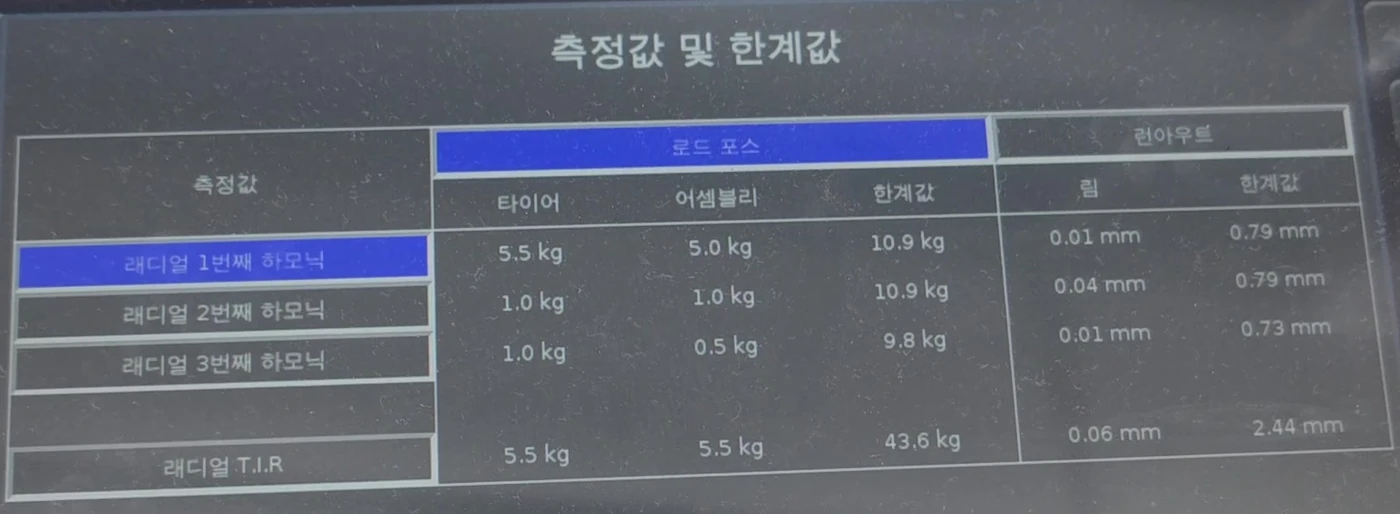
The four morning screens below show first-harmonic assembly RFV readings of 8.5, 2.0, 7.0 and 4.5 kg. The kg shown for road force and the mm shown for rim runout describe different quantities.
View the four initial RFV screens and readings
| Screen | Tyre RFV | Assembly RFV | Rim runout |
|---|---|---|---|
| A | 7.5 kg | 8.5 kg | 0.04 mm |
| B | 3.0 kg | 2.0 kg | 0.11 mm |
| C | 8.0 kg | 7.0 kg | 0.04 mm |
| D | 3.5 kg | 4.5 kg | 0.07 mm |
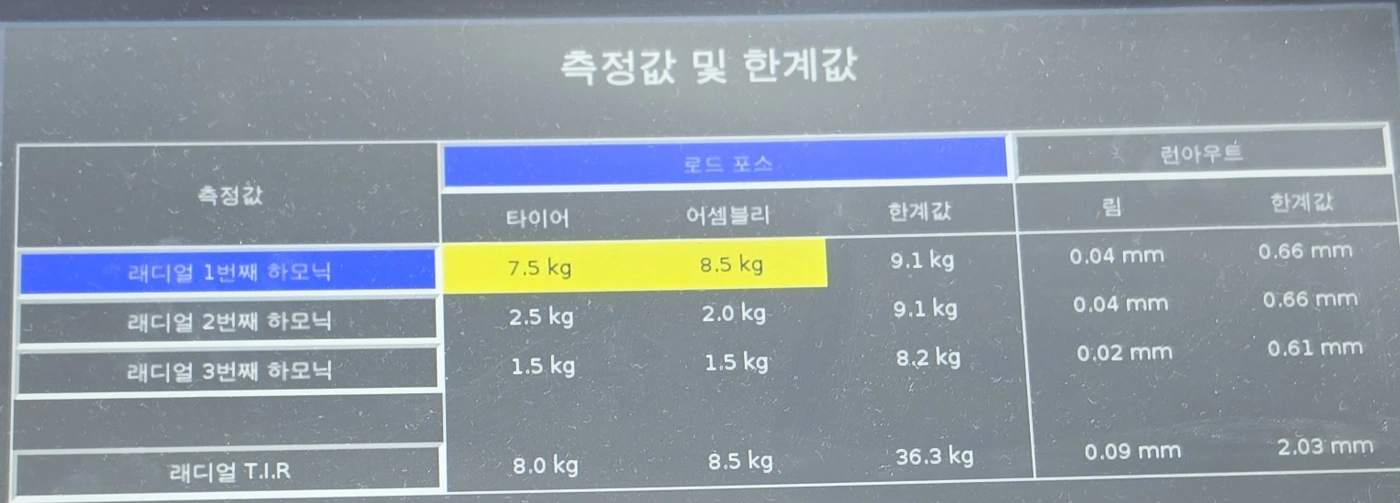
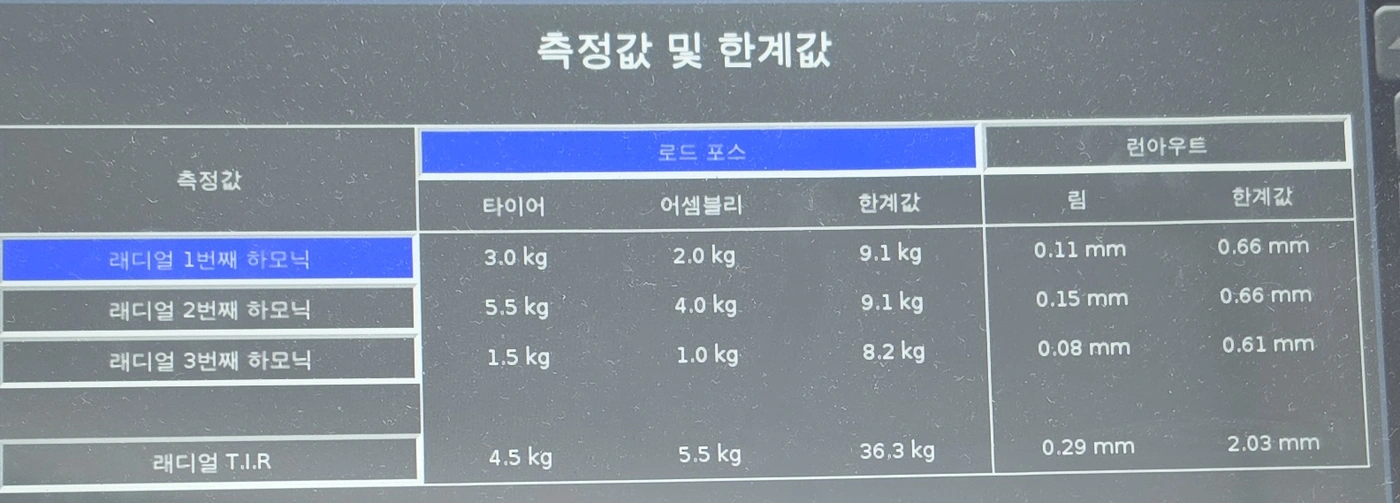
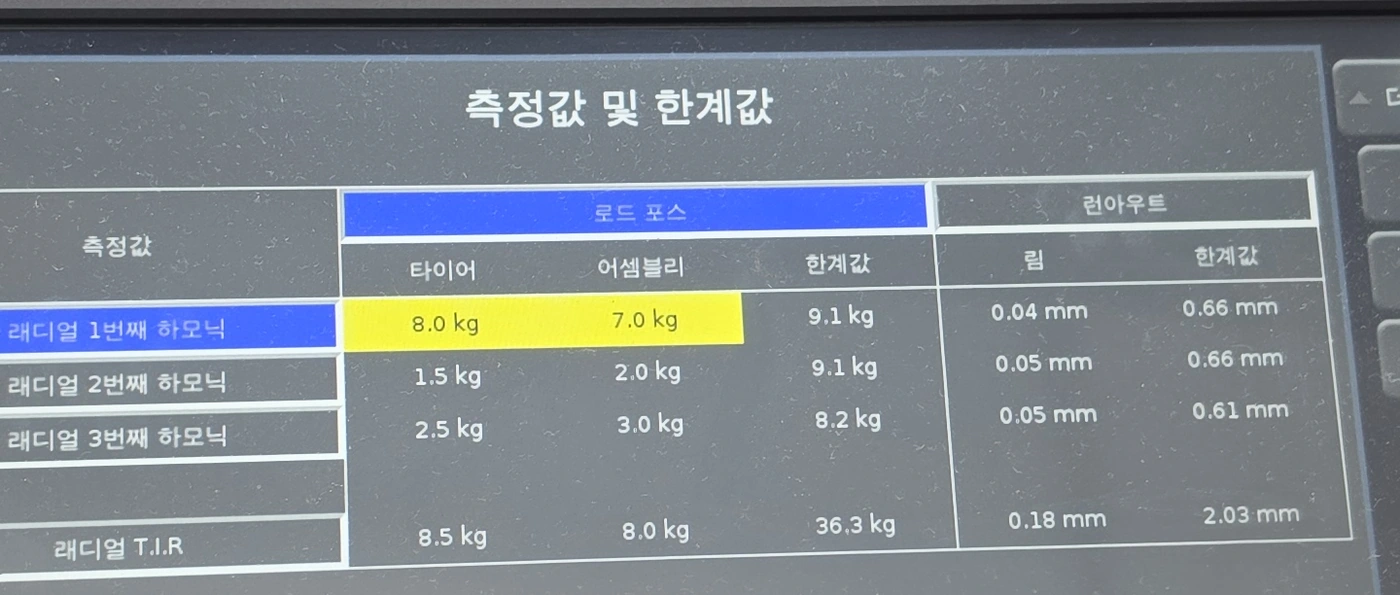
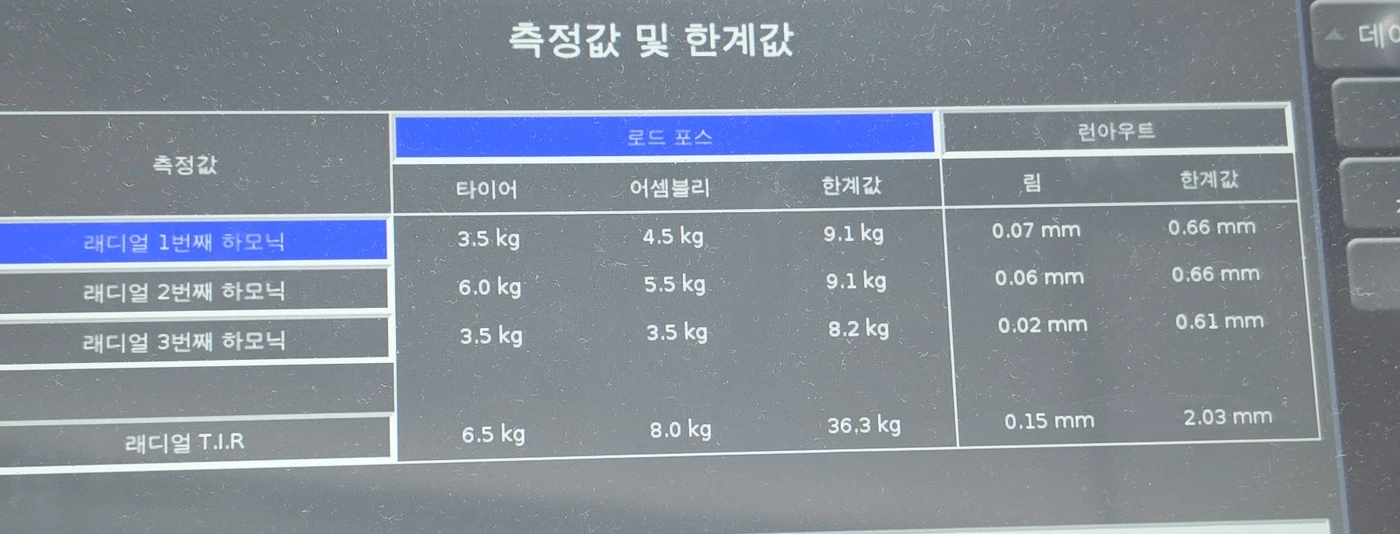
The first-harmonic limit displayed on these screens is 9.1 kg, while A and C are highlighted in yellow. A number below that limit does not by itself show that the car has no vibration. We continued with the other measurements and the actual driving symptoms.
03 / E300
We also measured the inside of the rims
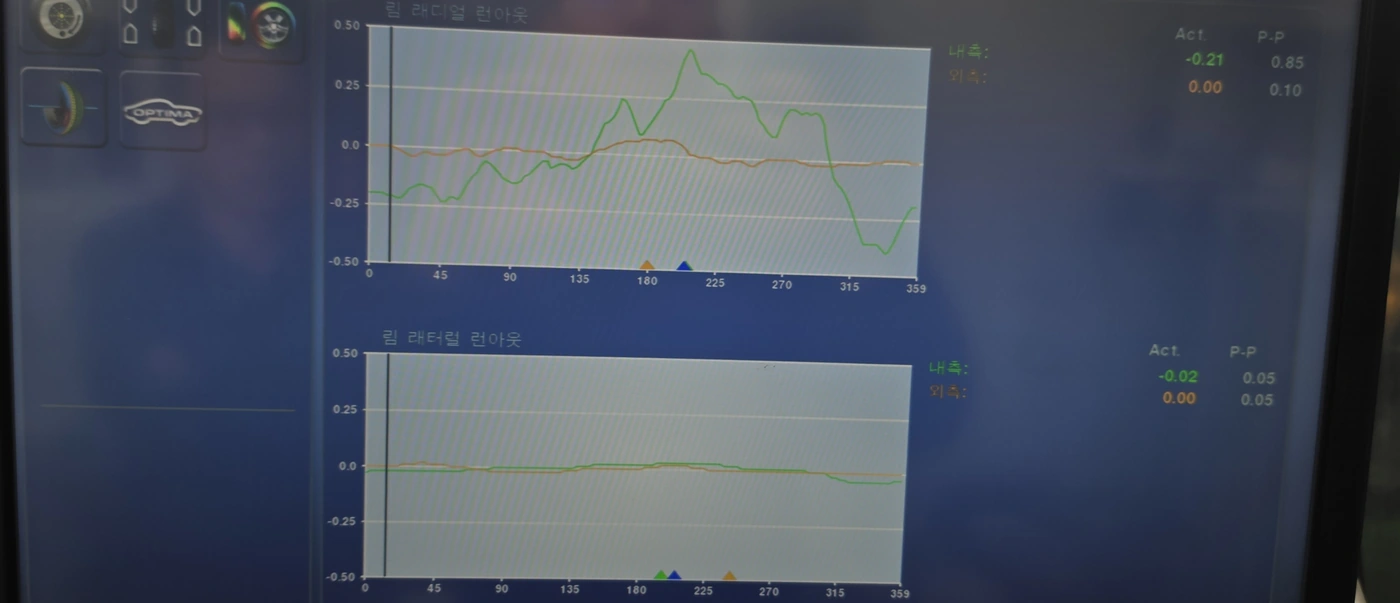
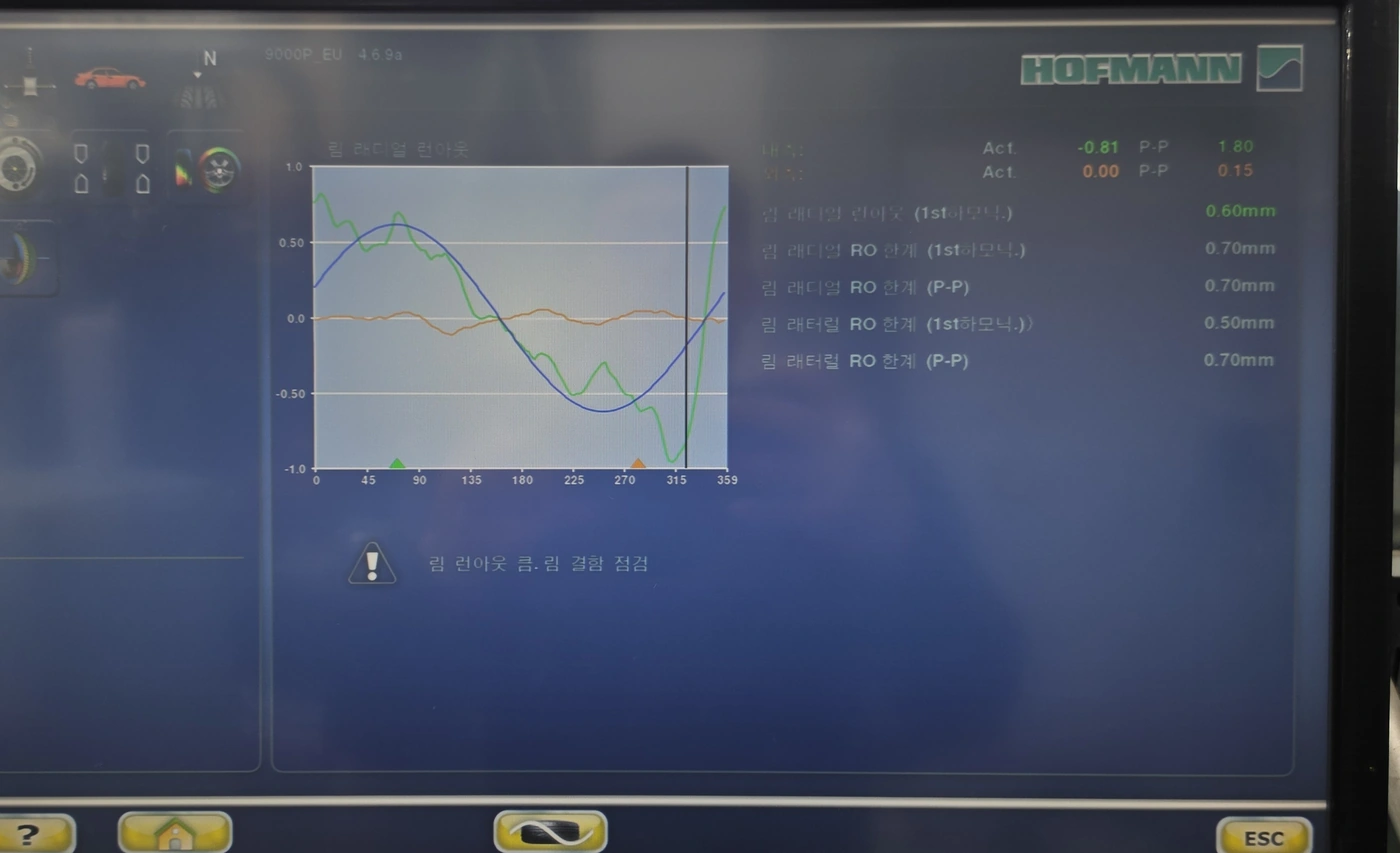
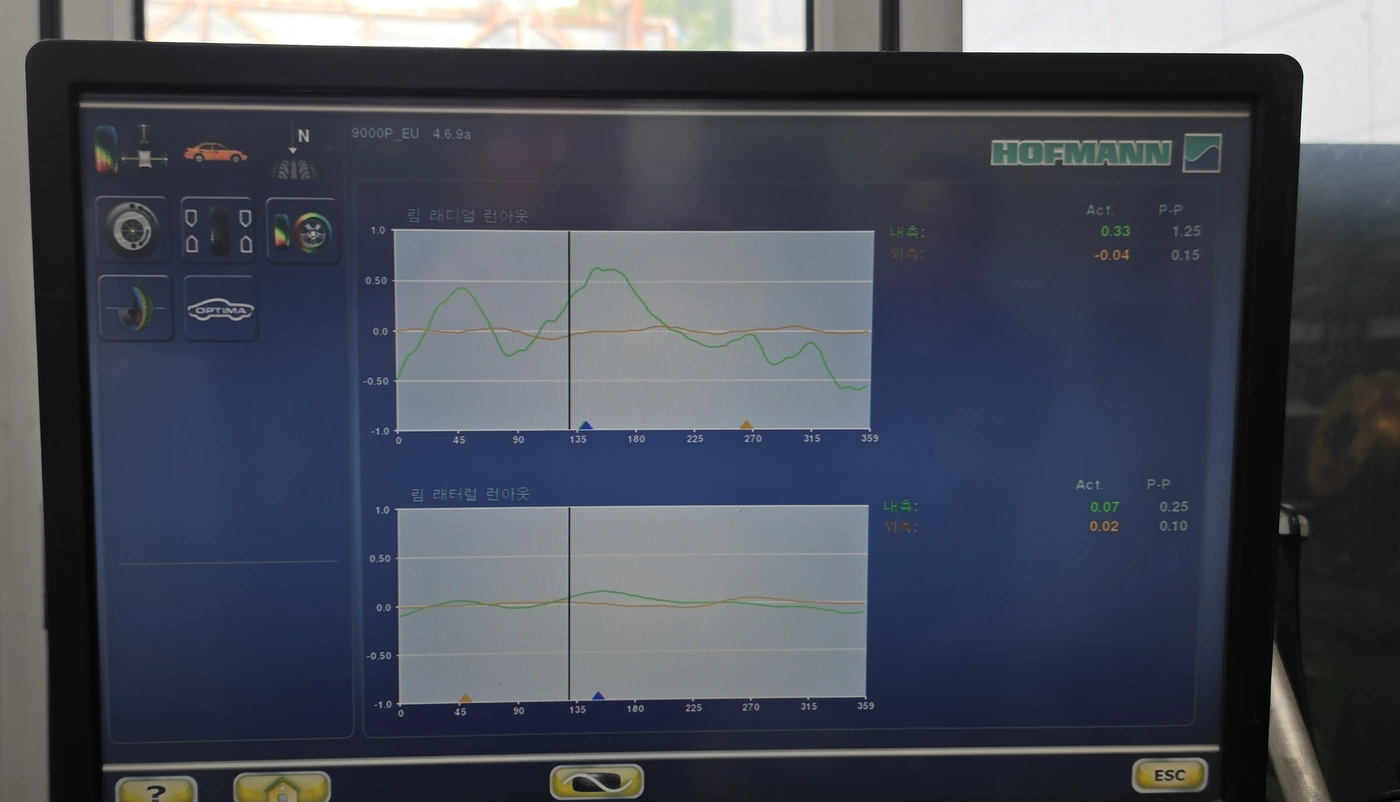
A wheel can look acceptable from outside while its inner rim does not run evenly. Separate measurement screens show inner radial peak-to-peak runout of 0.85, 1.80 and 1.25 mm. Each image shows an individual wheel measurement.
After wheel straightening and front tyre replacement, we carried out RFV matching and balancing. Matching changes the tyre’s position relative to the wheel. Checking rim movement and the force variation of the loaded assembly separately helps us judge what remains.
04 / E300
The road vibration readings came down
We compared the morning and afternoon NVH records. FT3 is the third-order component related to front tyre rotation. The component that was prominent in the morning was lower in the afternoon records.
At 105–109 km/h, detected FT3 average amplitude was 0.4053 g, then 0.1639 g and 0.0603 g. Here g is acceleration, distinct from balancing-weight mass or the road-force machine’s kg display.

| Record time | Record length | Overall FT3 average | At 105–109 km/h |
|---|---|---|---|
| 09:04 | 4:19.0 | 0.3186 g | 0.4053 g |
| 13:03 | 3:39.5 | 0.1331 g | 0.1639 g |
| 13:05 | 1:23.0 | 0.0533 g | 0.0603 g |
The afternoon records show a lower front tyre third-order amplitude than the morning record.
05 / E300
Wheel alignment was adjusted after the road test
Alignment was checked after the afternoon NVH records. Front toe was 2.3 mm left and 3.6 mm right. At the rear, the left was −0.8 mm and the right 1.0 mm: the left rear was pointing in the opposite toe direction.
After adjustment, front toe was 1.2 / 1.1 mm and rear toe 1.9 / 1.9 mm. Displayed rear total toe changed from 0.2 to 3.9 mm and thrust angle from −0.07° to 0.00°. Zero toe is not the target for every car. We adjusted left and right toe within the selected settings so that the wheels would track in the intended direction.
Before adjustment
Rear left: toe-out → toe-in
After adjustment
Rear toe balanced at 1.9 / 1.9 mm
| Reading | Before | After |
|---|---|---|
| Front left toe | 2.3 mm | 1.2 mm |
| Front right toe | 3.6 mm | 1.1 mm |
| Rear left toe | −0.8 mm | 1.9 mm |
| Rear right toe | 1.0 mm | 1.9 mm |
| Rear total toe | 0.2 mm | 3.9 mm |
| Thrust angle | −0.07° | 0.00° |
View the original alignment screens
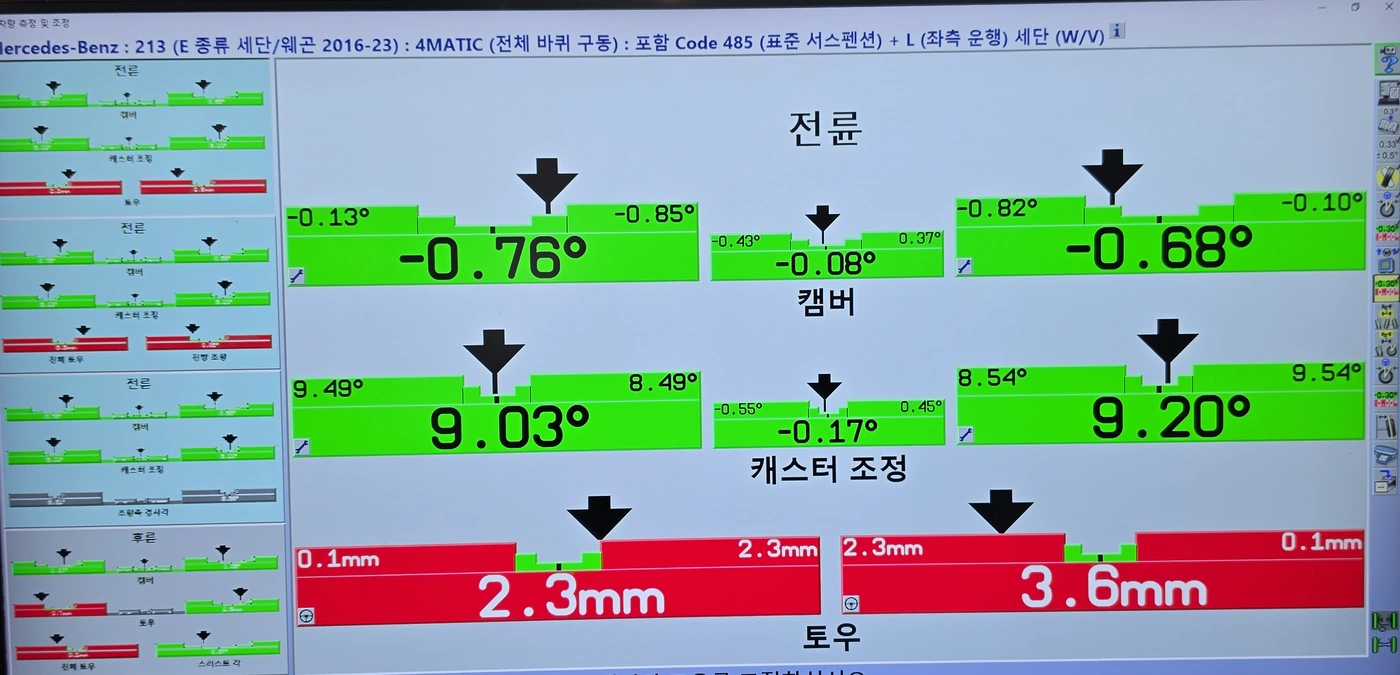
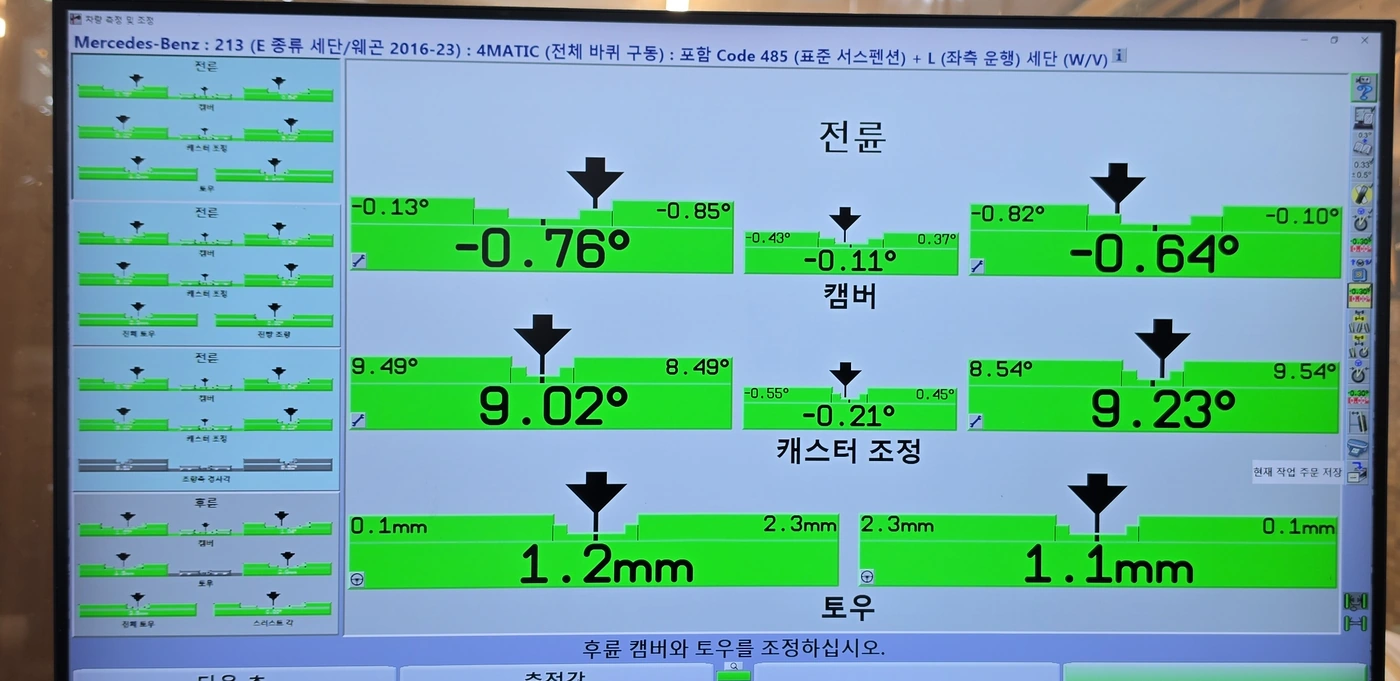
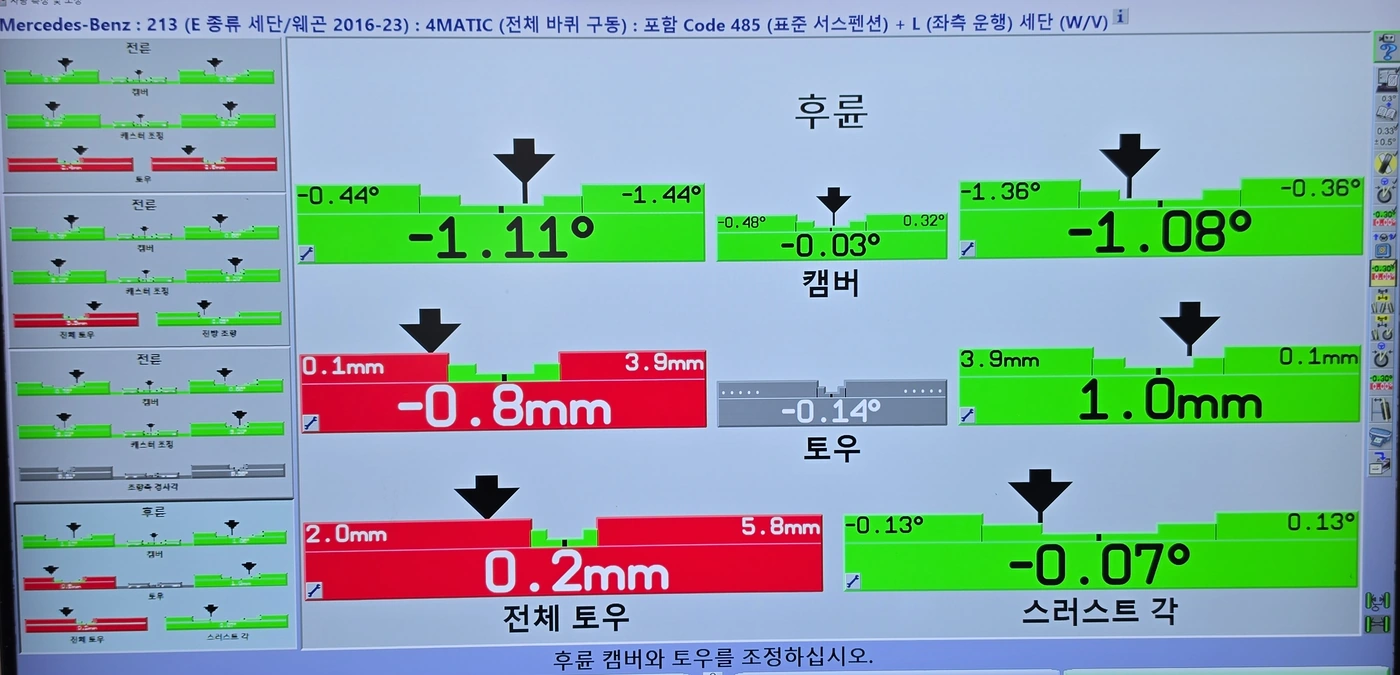
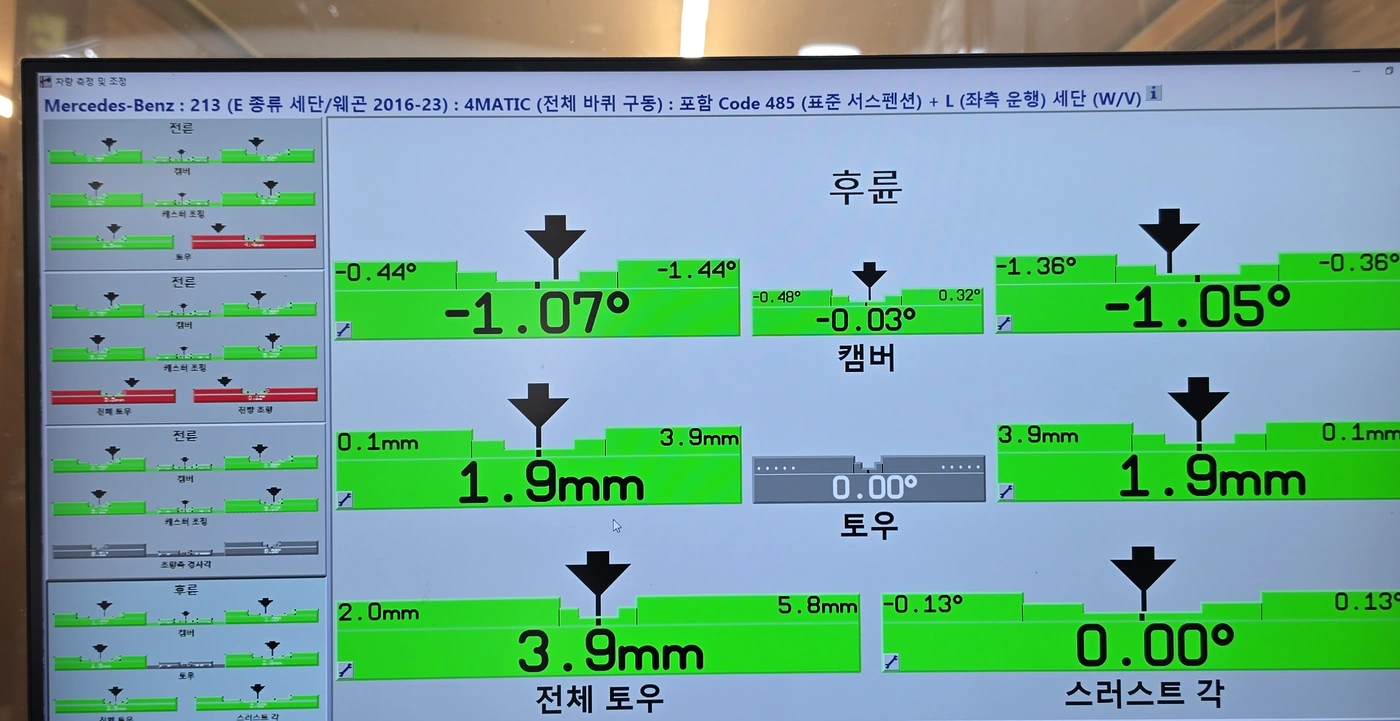
Camber was within the equipment’s selected range both before and after. Front camber changed from −0.76 / −0.68° to −0.76 / −0.64°; rear camber from −1.11 / −1.08° to −1.07 / −1.05°. Toe is the main adjustment comparison here.
We checked the change on the road after the wheel and tyre work, then adjusted alignment.
06 / E300
Tyre and wheel work reduced the vibration; alignment followed
If repeated balancing has not helped at the same road speed, it is worth checking how the rim runs, how the tyre behaves under load and when the vibration occurs. Those findings guide the next work.
The front tyres were replaced, the wheels straightened, and RFV matching and balancing completed before the change was checked on the road. Alignment was then adjusted so that the wheels would track in the intended direction. The strong vibration was reduced, but slight vibration remained under acceleration and was not felt when the accelerator was released. This difference remains a point for follow-up diagnosis.
Common questions
Can vibration remain after balancing?
Yes. Rim deformation and tyre force variation under load can remain after mass balance has been corrected. We checked runout, RFV and road vibration separately on this car.
Should toe always be set to zero?
No. Settings depend on the vehicle. This car’s rear toe was adjusted to 1.9 mm on each side, with displayed total toe of 3.9 mm within the selected range.
Tell us when the vibration appears
Please tell us the model, mileage, speed range and what you feel through the steering wheel or seat. Previous tyre and wheel work is also useful.
We explain the scope of any repairs and the estimate before proceeding with your approval.
Call 031-258-1617Book on NaverBy appointment · NHC Motors, Suwon